
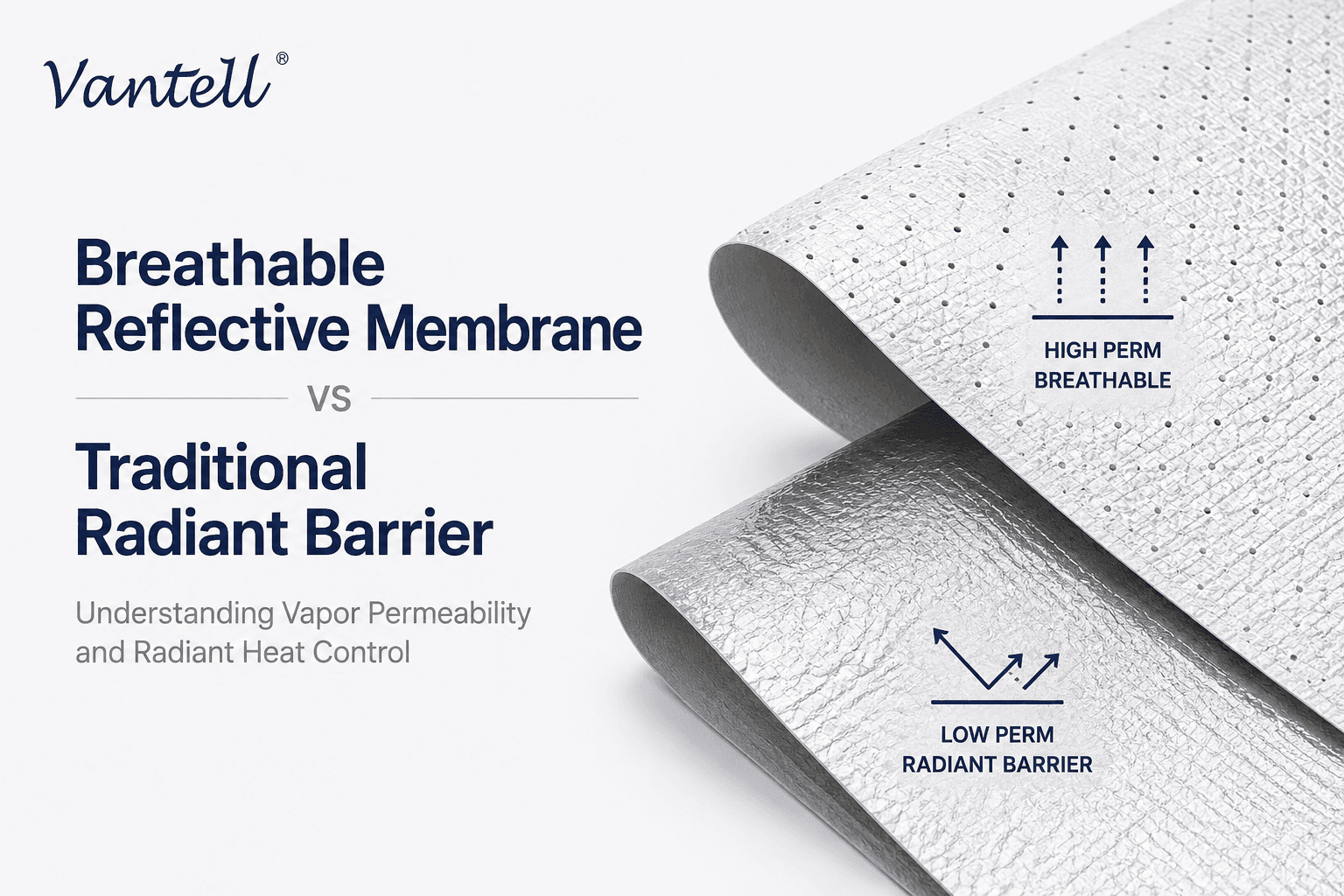
Breathable Reflective Membrane vs Traditional Radiant Barrier: Understanding Vapor Permeability and Radiant Heat Control
Reflective building membranes are easy to recognize but not always easy to classify. A silver or metallic surface may suggest that a product is a radiant barrier, yet two membranes that look similar can behave very differently when it comes to water vapor, liquid water and moisture management within a wall or roof assembly.
Some reflective membranes are intentionally designed with very low vapor permeability and may form part of a vapor-control strategy. Others are engineered to remain highly vapor open while still providing weather resistance and a reflective exterior surface.
This distinction is important because reflectivity, vapor permeability and liquid-water resistance are separate material properties. A reflective surface does not automatically make a membrane a vapor barrier, just as a vapor-permeable membrane does not automatically allow rainwater to pass through it.
What Is a Traditional Radiant Barrier?
A radiant barrier is designed primarily to reduce heat transfer by thermal radiation. It normally incorporates a low-emissivity reflective surface such as aluminum foil, metallized film or another reflective layer.
Unlike conventional bulk insulation such as mineral wool, fiberglass or rigid foam, a radiant barrier does not primarily work by slowing conductive heat flow through its thickness. Its function is to reduce radiant heat exchange between surfaces.
For this reason, the position of the reflective surface within the building assembly matters.
When a low-emissivity surface faces an air cavity, it can reduce the amount of radiant energy exchanged across that space. If the reflective surface is tightly sandwiched between solid materials, conductive heat transfer becomes much more important and the benefit of the reflective surface may be substantially reduced.
This is why reflective membranes should not simply be described as insulation based on their appearance or reflectance percentage alone.
Why Are Many Reflective Membranes Vapor Resistant?
Many conventional reflective membranes are produced using combinations of aluminum foil, polymer films, woven reinforcement, coatings and laminated layers.
These continuous layers can strongly restrict the movement of water vapor through the material. Depending on the construction, the finished membrane may therefore function as a vapor retarder or even a vapor barrier.
However, this low vapor permeability is not caused simply by the fact that the membrane is reflective.
The two properties should be considered independently:
- Reflectance and emissivity describe how a surface interacts with radiant energy.
- Vapor permeance describes how readily water vapor can diffuse through the material.
A membrane can therefore have a reflective surface while being either vapor resistant or highly vapor permeable, depending on how the complete material structure is engineered.
What Is a Reflective Breather Membrane?
A reflective breather membrane is designed to combine a reflective exterior surface with relatively high water-vapor permeability.
Instead of forming a strong vapor-control layer, the membrane allows water vapor to diffuse through the building envelope while continuing to provide exterior weather protection.
Depending on the product and assembly, a reflective breather membrane may provide several functions:
- Resistance to bulk liquid water
- High vapor permeability
- Exterior weather protection
- Mechanical reinforcement
- A reflective surface
- Support for outward drying of the assembly
In exterior wall construction, this type of material is closer in function to a reflective weather-resistive barrier than to a conventional foil vapor barrier.
In suitable pitched roof assemblies, the same principle can be used to create a vapor-open reflective underlay that supports outward drying while introducing a reflective surface into the roof system.
Vapor Permeable Does Not Mean Water Permeable
One of the most common misunderstandings surrounding breathable membranes is the assumption that a material capable of passing water vapor must also allow liquid water to pass through.
These are two different transport mechanisms.
Water vapor can move through a membrane by molecular diffusion. Liquid water, by comparison, is affected by hydrostatic pressure, gravity, capillary action, surface tension and the physical structure of the membrane.
It is therefore entirely possible to engineer a membrane that combines:
- High water-vapor permeance
- Resistance to liquid-water penetration
- Useful mechanical strength
This principle is fundamental to modern vapor-permeable weather-resistive barriers. The objective is not to create an openly porous sheet through which both air and water can freely pass, but to engineer the membrane so that different forms of moisture are controlled in different ways.
VREFLECT: A High-Perm Reflective Breather Membrane
Vantell VREFLECT Reflective Breather Membrane was developed for wall and roof assemblies where reflective surface performance must be combined with high vapor permeability and exterior water resistance.
The membrane achieves approximately 29 US perms of water vapor permeance, corresponding to an approximate equivalent air layer thickness (sd-value) of 0.12 m.
At the same time, VREFLECT remained watertight under a 55 cm static water head for five hours.
Its reflective exterior surface provides a reflectance of ≥85%.
| Property | Performance |
|---|---|
| Reflectance | ≥85% |
| Water Vapor Permeance | 29 US perms |
| Equivalent Air Layer Thickness (sd) | Approx. 0.12 m |
| Water Resistance | No leakage at 55 cm hydrostatic head for 5 hours |
| Breaking Force — MD | 396 N |
| Breaking Force — CD | 214 N |
| Elongation — MD | 99% |
| Elongation — CD | 107% |
This combination illustrates an important point in building-envelope design: a membrane can remain highly vapor permeable while still resisting substantial liquid-water pressure and providing a reflective exterior surface.
For full technical information, see the VREFLECT Reflective Breather Membrane product page.
How Can a Membrane Be Both Breathable and Water Resistant?
Different membrane technologies achieve vapor permeability in different ways, but the underlying principle is that vapor transport occurs on a very different scale from liquid-water penetration.
Several broad approaches are used in breathable membrane technology.
Microporous Structures
Microporous materials contain extremely small pathways that allow water vapor to move through the membrane while resisting the penetration of liquid water under intended service conditions.
Monolithic Breathable Films
Some breathable films use molecular transport through a continuous polymer layer rather than relying on conventional open pores. Water vapor can migrate through the material without creating a direct pathway for bulk liquid water.
Composite Membrane Structures
A finished building membrane may combine multiple functional layers to balance vapor permeability, water resistance, mechanical strength, dimensional stability and surface properties.
A reflective surface can be integrated into such a structure provided that the complete membrane remains sufficiently vapor open for its intended building-envelope function.
This is why the complete membrane construction matters far more than whether the surface simply looks metallic.
Reflective Breather Membrane vs Traditional Radiant Barrier
| Property | Reflective Breather Membrane | Traditional Radiant Barrier |
|---|---|---|
| Reflective Surface | Yes | Yes |
| Radiant Heat Control | Additional function when correctly positioned | Primary function |
| Vapor Permeability | Moderate to high | Typically low |
| Bulk Water Resistance | Product dependent | Product dependent |
| Vapor-Control Role | Normally vapor open | Often vapor retarding |
| Outward Drying Potential | Higher | Lower |
| Typical Wall Role | Exterior breather membrane / WRB | Radiant or vapor-control layer |
| Typical Roof Role | Breathable reflective underlay | Radiant barrier or reflective vapor-control layer |
Neither construction is universally better.
They are designed to solve different building-envelope problems.
A vapor-open exterior assembly may benefit from a reflective breather membrane because it allows moisture within the wall or roof to continue drying toward the exterior. An assembly requiring strong vapor control may instead require a much lower-permeance reflective membrane.
Why Outward Drying Matters
Moisture can enter a wall or roof assembly through construction moisture, small air leaks, incidental rain exposure, indoor humidity or other mechanisms.
Once moisture enters the assembly, the ability of the structure to dry becomes an important part of long-term durability.
In a vapor-open system, the exterior membrane is intentionally selected so that it does not create a strong vapor barrier on the cold or exterior side of the assembly.
This is especially relevant in timber-frame, lightweight steel and other highly insulated construction systems where moisture accumulation within sheathing or insulation layers can become a durability concern if drying paths are restricted.
A reflective breather membrane allows the designer to retain this outward drying potential while adding a reflective exterior surface.
Where Does a Reflective Breather Membrane Make Sense?
Timber-Frame Exterior Walls
Timber-frame walls commonly use a vapor-permeable exterior WRB to protect sheathing from exterior water while allowing moisture within the wall to migrate outward.
A reflective breather membrane can perform this exterior weather-protection role while also introducing a reflective surface where the wall configuration includes a suitable cavity.
Light-Gauge Steel Construction
Lightweight steel assemblies can also benefit from vapor-open exterior membranes, particularly where the wall design relies on exterior drying and ventilated cladding.
Mechanical strength becomes particularly important during large-area installation, making reinforced membrane construction valuable in exposed jobsite conditions.
Ventilated Facades and Rainscreen Assemblies
Rainscreen systems intentionally create a drainage and ventilation cavity behind the exterior cladding.
This cavity can provide the air space required for a reflective surface to contribute to radiant heat control while the membrane behind it continues to perform as the water-resistive and vapor-permeable layer.
Pitched Roof Assemblies
Pitched roofs may include ventilated cavities beneath tile, metal or other roof coverings.
Where the roof underlay must remain vapor open, a reflective breather membrane can provide a different moisture-management strategy from a conventional vapor-resistant foil radiant barrier.
Hot-Climate Building Envelopes
Roofs and walls exposed to strong solar radiation can experience high exterior surface temperatures.
In these conditions, combining a reflective surface with a ventilated cavity can help manage radiant heat transfer, while a vapor-open membrane continues to support moisture drying.
When Is a Traditional Radiant Barrier More Appropriate?
High vapor permeability is not required in every wall or roof assembly.
A conventional radiant barrier may be more appropriate where the design requires:
- Very low vapor permeability
- A dedicated vapor-control layer
- A low-emissivity surface facing an air cavity
- Radiant heat control as the primary function
- A reinforced reflective layer for demanding roof applications
For these applications, a reinforced aluminum-based membrane may provide a more suitable balance of vapor control, durability and radiant performance.
Vantell's VRAU Series is developed for this different application strategy, using a reinforced real-aluminum reflective surface for hot-climate roofing and demanding installation environments.
Do Not Select a Reflective Membrane by Reflectance Alone
Reflectance is an important property, but it is only one part of membrane performance.
A specification such as 85%, 95% or 97% reflectance does not by itself explain how a membrane will perform within a real wall or roof assembly.
Depending on the application, designers should also consider:
- Surface emissivity
- Vapor permeance
- sd-value
- Water resistance
- Breaking strength
- Tear resistance
- Fastener resistance
- UV exposure
- Temperature stability
- Reinforcement
- Membrane orientation
- Cavity ventilation
- Presence of an adjacent air space
A highly reflective membrane may still be unsuitable if its vapor behavior conflicts with the intended drying direction of the assembly.
Likewise, a highly vapor-permeable membrane should not be selected solely because of its perm rating if the required water resistance, mechanical durability or thermal configuration is not satisfied.
Reflective Breather Membrane or Radiant Barrier: How to Choose
A reflective breather membrane may be appropriate when:
- The exterior membrane needs to remain vapor open.
- Outward drying is part of the moisture-management strategy.
- The membrane also performs a WRB or roof-underlay function.
- Resistance to liquid water is required.
- A reflective surface can provide an additional benefit within a correctly designed cavity.
A conventional radiant barrier may be more appropriate when:
- Low vapor permeability is acceptable or intentionally required.
- The membrane forms part of the vapor-control strategy.
- A low-emissivity surface faces a suitable air space.
- Radiant heat control is the primary design objective.
- A robust reinforced reflective layer is required for roof installation.
The Membrane Must Be Evaluated as Part of the Complete Assembly
The most important conclusion is that a reflective membrane cannot be selected from surface appearance alone.
Two silver membranes may look almost identical while having completely different vapor permeance, water resistance, reinforcement and intended positions within the building envelope.
A good membrane specification therefore starts with the requirements of the complete wall or roof assembly:
- Where should the assembly be able to dry?
- Does the membrane need to resist liquid water?
- Is vapor control required at this location?
- Will the reflective surface face an air space?
- What mechanical stresses will occur during installation?
- What temperature and UV exposure will the membrane experience?
Only after answering these questions does it make sense to decide whether a vapor-open reflective breather membrane or a conventional radiant barrier is the better solution.
Conclusion
Reflective breather membranes and traditional radiant barriers may share a similar metallic appearance, but they can perform very different roles within a building envelope.
A traditional radiant barrier generally prioritizes a low-emissivity surface and radiant heat control, often together with relatively low vapor permeability.
A reflective breather membrane such as Vantell VREFLECT takes a different approach by combining a reflective surface with high vapor permeability, resistance to liquid water and reinforced mechanical performance.
With ≥85% reflectance, approximately 29 US perms of vapor permeance and no leakage under a 55 cm hydrostatic head for five hours, VREFLECT demonstrates that reflective performance, vapor openness and exterior water resistance do not have to be mutually exclusive.
Most importantly, reflectance, vapor permeability and liquid-water resistance should always be evaluated as separate properties within the context of the complete wall or roof assembly.