
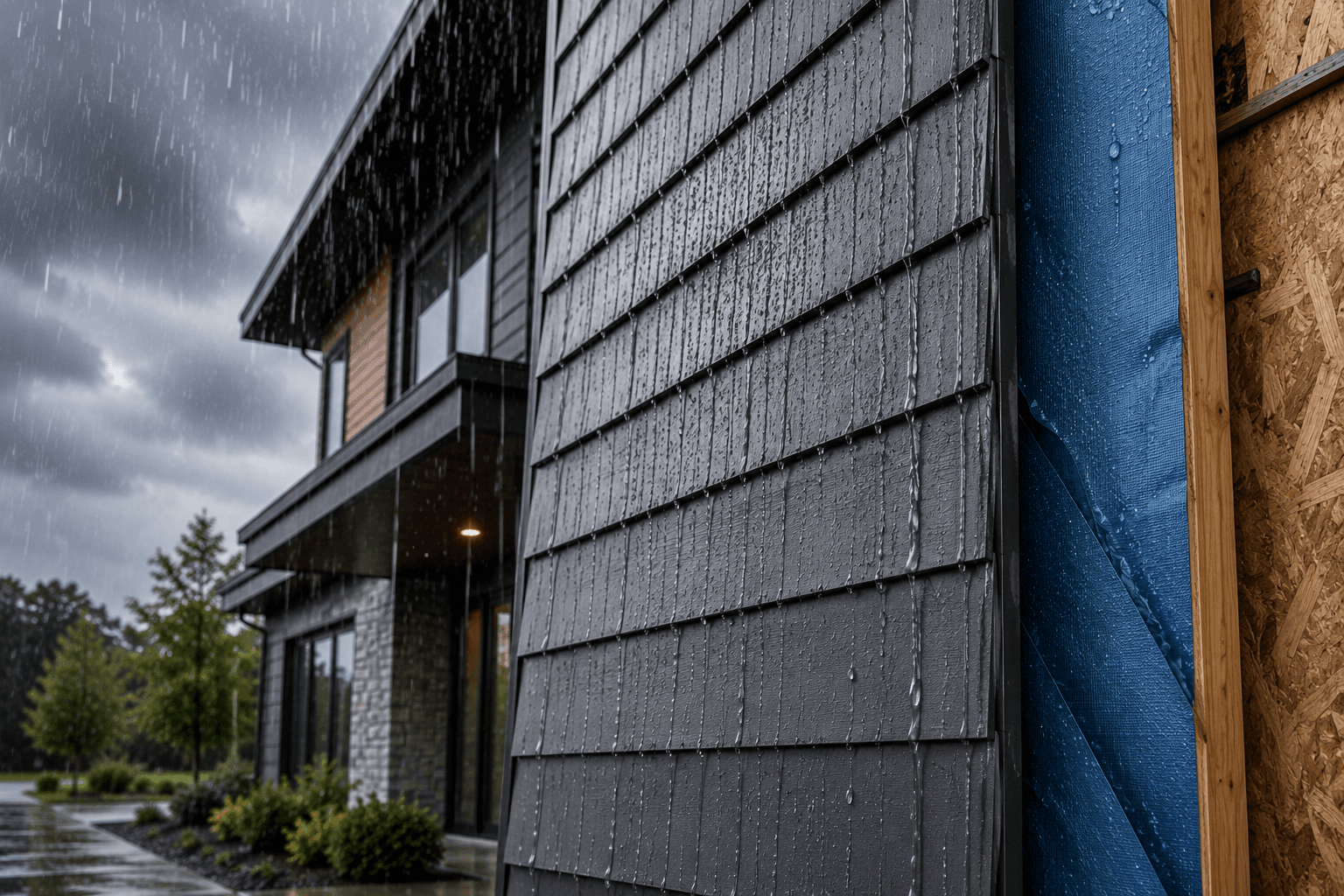
Moisture management is one of the most important parts of building envelope design. In many wall assemblies, water intrusion is not only caused by bulk water leakage or rain exposure, but also by a less visible mechanism: capillary action.
Capillary action can hold and move liquid water through very small gaps between building materials. When exterior cladding, WRB, sheathing or other wall components are pressed closely together, water can be retained in the interface instead of draining freely. Over time, this trapped moisture may increase the risk of sheathing deterioration, mold growth, corrosion, staining, reduced insulation performance and long-term wall durability problems.
What Is Capillary Action?
Capillary action is the movement of liquid water through narrow spaces, pores or contact gaps due to surface tension and adhesion between water and the surrounding material surfaces.
In building envelopes, capillary action may occur in areas such as:
- Small gaps between cladding and WRB
- Interfaces between sheathing panels and exterior membranes
- Joints, laps, fastener penetrations and rough openings
- Porous materials such as wood, fiberboard, masonry or cement-based substrates
- Wall assemblies where materials are installed in direct contact without a drainage space
When the gap is very small, water may be held between the surfaces. Instead of flowing downward by gravity, it can spread laterally or remain trapped. This is why a wall can stay wet even when there is no obvious leak.
Why Capillary Moisture Matters in Wall Assemblies
A modern WRB or housewrap is designed to resist liquid water while allowing water vapor to pass through. However, vapor permeability alone does not solve every moisture problem. If liquid water is trapped in direct contact between the cladding and the WRB, the wall may not be able to drain and dry efficiently.
This risk becomes more important in high-humidity climates, coastal areas, rainy regions, shaded walls, and wall systems with absorbent or tightly installed exterior cladding. In these conditions, repeated wetting and slow drying can create a long-term moisture load inside the wall assembly.
Common Problems Caused by Trapped Capillary Water
- Slow drying: Water held between close-contact layers has limited airflow and limited drainage path.
- Wood decay risk: Sheathing and framing materials can be exposed to elevated moisture for a longer time.
- Mold and mildew risk: Persistent moisture can create conditions for biological growth.
- Corrosion: Fasteners, metal accessories and metal cladding components may be affected by repeated wetting.
- Reduced thermal performance: Wet materials and wet insulation can reduce wall performance.
- Exterior finish damage: Moisture accumulation may contribute to staining, blistering or coating failure.
Solution 1: Drainable Housewrap
A drainable housewrap is designed to provide water resistance, vapor permeability and drainage in one material layer. Unlike a flat WRB, a drainable housewrap includes an integrated drainage structure, textured surface or drainage path that helps create a small space between the WRB and the exterior cladding.
This drainage structure helps interrupt capillary contact and allows incidental water to move downward by gravity. Instead of being trapped between two flat surfaces, water has a defined path to drain out of the wall assembly.
How Drainable Housewrap Helps
- Reduces direct capillary contact between cladding and WRB
- Creates a drainage path behind the exterior cladding
- Allows bulk water to drain downward instead of remaining trapped
- Supports drying by allowing vapor to pass outward
- Improves moisture management without requiring a full furring-strip rainscreen system in every application
For many residential and light commercial wall assemblies, drainable housewrap can be a practical way to improve drainage performance while keeping installation relatively simple.
Solution 2: Rainscreen System
A rainscreen system creates a physical air gap between the exterior cladding and the WRB or sheathing layer. This gap separates the cladding from the water-resistive barrier and provides a dedicated space for drainage and ventilation.
In a rainscreen wall, any water that enters behind the cladding can drain downward through the cavity. At the same time, airflow within the cavity can help remove moisture and accelerate drying. This approach is especially useful for high-performance buildings, wet climates, absorbent cladding materials and wall assemblies where long-term durability is a priority.
How Rainscreen Systems Help
- Create a continuous drainage cavity behind the cladding
- Break capillary contact between cladding and WRB
- Improve drying through ventilation and air movement
- Reduce the risk of trapped moisture in the wall assembly
- Provide strong protection for demanding climate conditions and high-value buildings
Related Vantell Solutions
To address capillary moisture and improve wall drying performance, Vantell offers both drainable housewrap and rainscreen solutions for different building envelope requirements.
Vgelo Wrap Drainable Housewrap VWD52315
Vgelo Wrap Drainable Housewrap VWD52315 is designed for wall assemblies where water resistance, vapor permeability and drainage performance are required in one integrated layer. Its drainable structure helps create a drainage path behind exterior cladding, reducing the risk of water being held by capillary contact between flat wall surfaces.
This product is suitable for projects where builders want to improve drainage performance while keeping installation close to a standard housewrap system. It is a practical solution for residential and light commercial wall assemblies where enhanced moisture management is needed without adding a full rainscreen cavity.
Vgelo RainScreen 10.1 VWR523101
Vgelo RainScreen 10.1 VWR523101 is designed to create a more defined drainage and ventilation space behind exterior cladding. By separating the cladding from the WRB or sheathing surface, it helps break capillary contact, allows incidental water to drain downward, and supports drying through air movement within the wall cavity.
This solution is especially useful for high-humidity climates, high-performance wall assemblies, absorbent cladding materials, and projects where enhanced drainage and drying capacity are important.
Drainable Housewrap vs. Rainscreen: What Is the Difference?
Both drainable housewrap and rainscreen systems are used to reduce moisture problems behind exterior cladding, but they solve the problem in different ways. A drainable housewrap creates drainage paths within or on the surface of the WRB, while a rainscreen creates a larger physical cavity behind the cladding.
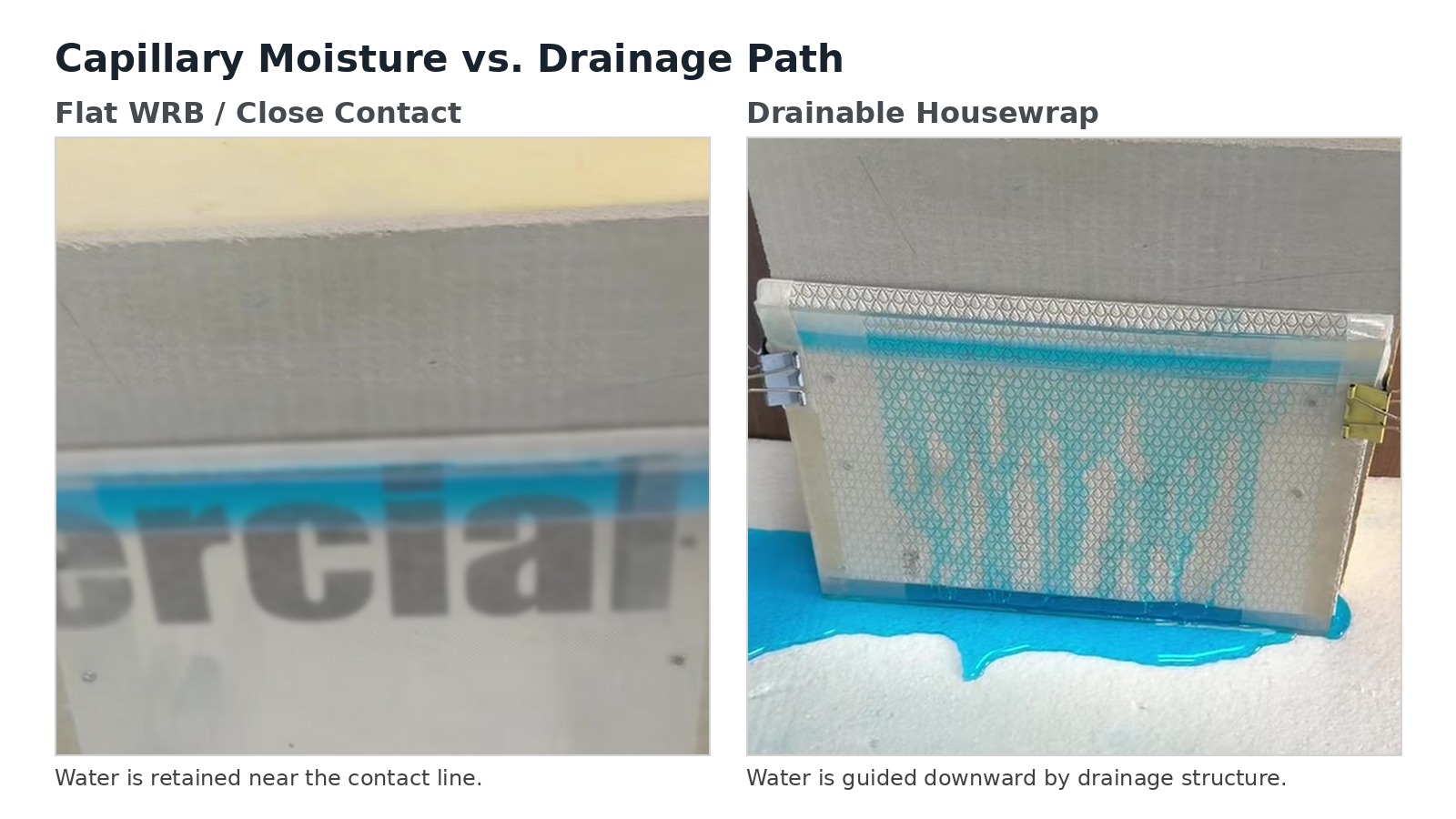
Compared with a flat WRB, a drainable housewrap helps reduce capillary water retention by providing a drainage path behind the exterior cladding.
| Item | Drainable Housewrap | Rainscreen System |
|---|---|---|
| Main Function | Water resistance, vapor permeability and integrated drainage | Drainage, ventilation and separation behind cladding |
| Drainage Method | Drainage channels or textured structure on the WRB surface | Physical air cavity created by furring strips, battens or drainage mats |
| Capillary Break | Reduces close-contact water retention | Creates a stronger physical separation |
| Installation | Similar to standard housewrap installation | Requires additional components and detailing |
| Typical Use | Residential and light commercial wall systems | High-performance walls, wet climates and demanding cladding systems |
| Cost and Complexity | Lower cost and simpler installation | Higher cost but stronger drainage and drying performance |
Design and Installation Considerations
Whether using a drainable housewrap or a rainscreen system, good detailing is critical. A drainage product can only perform properly when water is given a clear path to exit the wall assembly.
- Install the WRB with proper shingle-style laps so water sheds outward and downward.
- Seal critical joints, seams, penetrations and rough openings with compatible flashing tapes.
- Provide drainage outlets at the bottom of the wall, such as weeps or open drainage edges.
- Keep drainage paths continuous and avoid blocking them with sealant, mortar, insulation or trim components.
- Use proper flashing at windows, doors, transitions, corners and penetrations.
- For rainscreen systems, maintain a continuous cavity and ensure both drainage and ventilation are considered.
Conclusion
Capillary action is a real and important moisture mechanism in building envelope design. When wall layers are installed in direct contact, water can be held between materials and may not drain effectively. This can increase the risk of long-term moisture problems inside the wall assembly.
Drainable housewrap and rainscreen systems both help address this issue by creating a capillary break and providing a path for water to drain. Drainable housewrap offers a simple and efficient solution for many wall assemblies, while rainscreen systems provide a more robust drainage and ventilation strategy for demanding applications.
For best long-term performance, these products should be used as part of a complete building envelope moisture management system, including WRB / housewrap, flashing tapes, seam sealing, drainage or rainscreen layers, and critical-detail protection around openings and penetrations.