
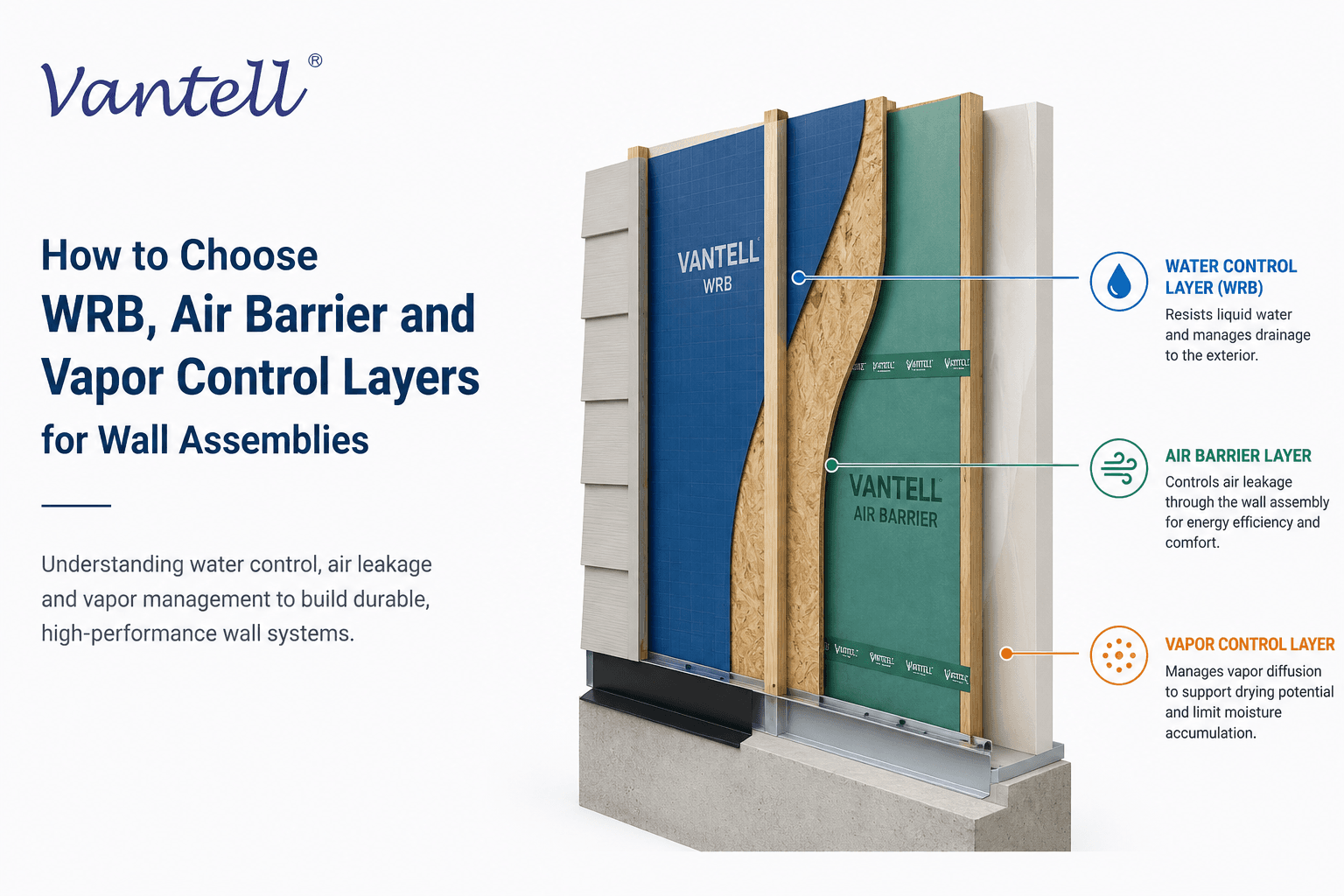
Wall assemblies do not fail simply because one material is “bad.” More often, they fail because the control layers are misunderstood, misplaced or interrupted.
A wall may have a good water-resistive barrier but still leak air. It may have an airtight membrane but trap moisture. It may use a high-perm WRB but still dry poorly because the cladding stores water. It may use a self-adhered membrane but fail at dusty sheathing, cold-weather installation, poor rolling pressure or weak window transitions.
That is why WRB, air barrier and vapor control layers should not be selected as separate product categories. They should be selected as a system.
A durable wall assembly needs to answer four questions:
- How does the wall shed liquid water?
- How does the wall drain incidental water?
- How does the wall control air leakage?
- How does the wall dry when moisture gets in?
Only after these questions are answered does product selection become meaningful.
1. WRB, air barrier and vapor control are different functions
In the building envelope, product names are often confusing. Housewrap, WRB, breathable membrane, air barrier, vapor barrier, vapor retarder and self-adhered membrane are sometimes used as if they mean the same thing.
They do not.
A WRB, or water-resistive barrier, is mainly intended to resist and drain liquid water that gets behind the exterior cladding.
An air barrier is intended to control air leakage through the enclosure.
A vapor control layer is intended to manage water vapor diffusion through materials.
These three functions can sometimes be provided by the same material, but they are not automatically the same function.
For example, a vapor-permeable housewrap may perform well as a WRB but may not become an effective air barrier unless seams, penetrations, openings and transitions are sealed. A self-adhered membrane may provide strong water and air control, but if its vapor permeance is too low for the assembly, it may reduce drying potential. A foil-faced or low-perm membrane may control vapor, but it may not be the right exterior WRB for a wall that needs outward drying.
The important point is simple:
A wall assembly does not perform according to product names. It performs according to whether the water, air and vapor control layers are continuous, compatible and correctly positioned.
2. Water control comes first
Bulk water is usually the largest moisture load a wall must manage. Rainwater can pass behind cladding through joints, cracks, fasteners, trim interfaces, window perimeters, masonry veneers, stucco cracks and panel joints.
The WRB is the secondary line of defense.
Its role is not only to “block water.” A good WRB strategy should also allow water to drain away from the assembly.
This means the WRB must be considered together with:
- cladding type;
- drainage space;
- shingle-lap direction;
- flashing integration;
- window and door detailing;
- fastener penetrations;
- UV exposure before cladding;
- jobsite tear resistance;
- tape and sealant compatibility.
A WRB that performs well in a laboratory water resistance test can still fail in the field if it is reverse-lapped, punctured, poorly taped or trapped behind a wet cladding with no drainage path.
For that reason, water control should be judged at two levels:
- Material level: Can the sheet resist liquid water?
- Assembly level: Can the installed wall drain liquid water reliably?
The second question is usually more important.
3. Drainage depends heavily on cladding type
Not all claddings create the same moisture load.
A wall behind vinyl siding or ventilated metal panels is not the same as a wall behind stucco, adhered stone veneer, brick veneer or fiber cement. Some claddings absorb and store water. Some dry quickly. Some create inward vapor drive when heated by the sun. Some leave a natural drainage space. Others press tightly against the WRB.
This matters because the WRB is not working alone. It is working behind a cladding system.
Reservoir claddings
Stucco, masonry veneer, adhered stone and some cementitious claddings can store water. After rain, they may remain wet and release moisture slowly. When solar heat drives that moisture inward, the WRB and sheathing may experience a stronger vapor and moisture load.
In these assemblies, a flat WRB may provide water resistance, but a drainage gap may still be needed to reduce water contact time. A drainable WRB or rainscreen space can help create a capillary break and drainage path.
Panel and lap siding
Fiber cement, engineered wood, vinyl siding and similar claddings vary widely in drainage and drying behavior. Some systems include drainage paths by design. Others rely heavily on laps, trim and back ventilation.
For these walls, WRB durability, tear resistance, seam sealing and flashing integration are often just as important as vapor permeance.
Open-joint claddings
Open-joint rainscreen systems may expose the WRB to more UV, wind and water than traditional covered assemblies. In these cases, ordinary housewrap may not be appropriate unless it is rated for the exposure conditions.
The basic rule is:
The more moisture the cladding stores or exposes to the WRB, the more carefully the WRB’s drainage, durability and exposure resistance must be evaluated.
4. Air leakage is often more dangerous than vapor diffusion
Vapor diffusion receives a lot of attention, but uncontrolled air leakage can transport far more moisture into a wall assembly.
Warm, moist air moving through cracks, seams and penetrations can reach cold surfaces inside the wall and condense. This is especially risky in cold climates, mixed climates and high-humidity interiors.
This is why air barrier continuity is critical.
A membrane may have excellent air resistance as a material, but the installed wall can still leak air through:
- untaped WRB seams;
- unsealed sheathing joints;
- gaps around windows and doors;
- unsealed pipe and duct penetrations;
- floor-line transitions;
- roof-to-wall transitions;
- damaged or torn WRB;
- poorly adhered tape;
- unsupported membrane areas;
- fastener holes in sensitive areas.
For a WRB to contribute to air control, the whole system must be detailed as an air barrier. This includes the membrane, tapes, flashings, sealants and transitions to adjacent assemblies.
A mechanically attached WRB can contribute to air control when properly taped and integrated, but it is more vulnerable to billowing, wrinkles and discontinuities. A self-adhered WRB can improve air-control continuity because it bonds to the substrate, but only if installation conditions allow proper adhesion.
The air barrier question is therefore not:
Is the product airtight?
The better question is:
Can this product become a continuous air-control layer after real jobsite installation?
5. Vapor control is about drying potential, not just perm rating
Vapor permeance is often misunderstood.
A high-perm WRB is not automatically better. A low-perm membrane is not automatically dangerous. The right vapor permeance depends on where the membrane is placed and how the wall is expected to dry.
The key concept is drying potential.
Every wall assembly should ideally have at least one practical drying direction. Moisture can enter a wall from rain leakage, construction moisture, indoor humidity, outdoor humidity, air leakage or vapor drive. Once moisture enters, the wall needs a way to release it before it accumulates.
A vapor-permeable WRB can support outward drying. This is often beneficial for framed wall assemblies where incidental moisture in the sheathing or cavity needs to escape toward the exterior.
A lower-perm exterior membrane can be useful in some designs, especially when vapor drive must be controlled or when the membrane is part of a specific air and vapor control strategy. But it must be coordinated with the rest of the wall.
Problems can occur when low-perm layers are placed on both sides of moisture-sensitive sheathing. This may create a double vapor-control condition, reducing the ability of the wall to dry inward or outward.
Examples of low-drying-risk combinations and high-drying-risk combinations depend on climate, insulation ratio, cladding type and interior conditions. The point is not that one material category is always safe or unsafe. The point is that vapor control must be designed, not guessed.
A practical question for buyers is:
If this wall gets wet, where will the moisture go?
If the answer is not clear, the vapor-control strategy needs more review.
6. Climate changes the answer
The same WRB can be appropriate in one climate and risky in another.
Cold climates
In cold climates, indoor moisture can move outward during winter. If warm indoor air leaks into the wall and reaches cold sheathing, condensation risk increases. Air sealing becomes very important. Interior vapor control may also be required depending on the assembly.
If the exterior layer is too vapor-closed and the sheathing is cold, outward drying can be limited. However, exterior continuous insulation can warm the sheathing and reduce condensation risk when properly designed.
Hot-humid climates
In hot-humid climates, vapor drive may often be inward. Solar heating of wet cladding can push moisture inward. If the interior is air-conditioned, inward vapor drive can become important.
In these assemblies, simply using the most vapor-open exterior membrane may not always solve the problem. Cladding drainage, inward vapor drive, interior finishes and air-conditioning conditions must be considered.
Mixed climates
Mixed climates are more complicated because vapor drive can reverse seasonally. The wall may need drying flexibility in both directions. Overly vapor-closed layers on both sides can be risky unless the assembly is specifically designed for that condition.
Marine and high-rainfall climates
In high-rainfall regions, bulk water management and drying are often more important than small differences in vapor permeance. Drainage, flashing and cladding back-ventilation become critical.
The selection logic should therefore be climate-aware:
The right WRB is not only a product choice. It is a climate and assembly choice.
7. Exterior insulation changes the wall physics
Exterior continuous insulation can improve thermal performance and reduce thermal bridging, but it also changes moisture behavior.
When insulation is placed outside the sheathing, the sheathing becomes warmer in cold weather. This can reduce condensation risk because the sheathing is less likely to fall below dew point. In that case, some lower-perm exterior layers may be easier to justify, depending on the full assembly.
However, exterior insulation can also reduce outward drying, especially if the insulation or exterior membrane is vapor-closed. If the wall also has an interior vapor-control layer, drying may become limited.
The effect depends on:
- type of exterior insulation;
- insulation thickness;
- ratio of exterior to cavity insulation;
- vapor permeance of insulation;
- vapor permeance of WRB or membrane;
- interior vapor control;
- climate zone;
- cladding ventilation.
This is why product selection should not be made by membrane data alone. A WRB with the same perm rating may behave differently in a wall with exterior mineral wool than in a wall with foil-faced polyiso or closed-cell foam.
For OEM and project buyers, the right question is:
What assemblies will this membrane most commonly be used in?
A product designed for one wall type may not be the safest universal choice for another.
8. Mechanically attached WRB: practical, economical, but detail-sensitive
Mechanically attached WRB remains widely used because it is cost-effective, familiar to installers and suitable for many standard wall assemblies.
Its strengths include:
- economical installation;
- easy handling;
- broad market familiarity;
- good outward drying potential when vapor-permeable;
- compatibility with many common cladding systems.
However, its performance depends heavily on installation quality.
Common risks include:
- tears during installation;
- wind damage before cladding;
- improper fastening;
- loose or wrinkled areas;
- untaped or poorly taped seams;
- reverse laps;
- poor window integration;
- unsealed penetrations;
- long UV exposure beyond product limits.
In many failures, the WRB sheet itself is not the main problem. The problem is discontinuity.
A mechanically attached WRB is therefore a good solution when the market values cost efficiency and installers can follow correct lap, fastening and flashing details.
It becomes less reliable when the project expects high air-control performance but does not enforce seam sealing, transition detailing and inspection.
9. Self-adhered WRB: stronger continuity, higher installation discipline
Self-adhered WRB can reduce several weaknesses of mechanically attached systems. Because the membrane bonds directly to the sheathing, it can improve contact, reduce billowing and support a more continuous water and air-control layer.
This can be valuable for:
- higher-performance wall assemblies;
- projects targeting improved airtightness;
- complex wall geometry;
- panelized construction;
- projects where fewer mechanical fasteners are preferred;
- applications where water-control continuity is critical.
But self-adhered WRB is not automatically superior in every project.
It is more sensitive to:
- dusty OSB or plywood;
- wet sheathing;
- cold installation temperatures;
- uneven substrates;
- poor rolling pressure;
- improper overlap;
- substrate movement;
- adhesive compatibility;
- long-term heat exposure;
- repair difficulty after misapplication.
A self-adhered WRB can be a high-performance system, but only when the jobsite can support correct installation. If a market has inconsistent sheathing quality, dusty construction environments, low labor training or cold-weather application, the adhesive system must be designed and validated for those conditions.
For manufacturing and OEM decisions, this is important:
The adhesive is not only a bonding layer. It is a risk-management component.
Its formulation affects installation temperature, peel strength, repositioning, long-term adhesion, compatibility and aging behavior.
10. The tape system determines whether the control layers remain continuous
WRB selection is incomplete without tape and flashing selection.
The most vulnerable areas of a wall are usually:
- seams;
- inside and outside corners;
- window openings;
- door openings;
- pipe penetrations;
- fastener penetrations;
- wall-to-roof transitions;
- wall-to-foundation transitions;
- repairs and patches.
These are not secondary details. They determine whether the installed WRB can function as a system.
Different tapes serve different functions.
Seam tape
Seam tape is used for WRB overlaps and sheathing joints where continuity is required. It should be compatible with the WRB surface and maintain adhesion under jobsite conditions.
Flashing tape
Flashing tape is used around windows, doors and transitions where water-shedding and substrate compatibility are critical. It often needs stronger conformability and adhesion to multiple substrates.
Vapor-permeable exterior tape
Vapor-permeable exterior tape is useful where the exterior side should remain more open to drying while still controlling water and air at the joint.
Vapor-control interior tape
Vapor-control interior tape is useful where the interior side of a window or wall transition needs stronger air and vapor control.
Deck tape and roof deck tape
Deck tape and roof deck tape are used for deck framing, roof deck seams, fastener sealing or water-shedding protection in specific applications. They should not be confused with ordinary WRB seam tape.
The correct tape is not simply the strongest adhesive. It is the tape that matches the substrate, exposure, vapor strategy and movement conditions.
A good tape selection process should ask:
- What substrate will it bond to?
- Is the substrate smooth, rough, porous or dusty?
- Will it be exposed to UV?
- Is low-temperature application required?
- Does the joint need vapor openness or vapor control?
- Will it be covered quickly?
- Will it be stretched, folded or installed around corners?
- Is nail sealability required?
- Does it need to bond to WRB, OSB, aluminum, steel, PVC, concrete or sheathing board?
This is where a system supplier can create real value. The membrane and tape should be developed and tested together, not selected separately from different catalogs.
11. Window openings reveal whether the system is actually designed
The field of the wall is usually easier. Openings are harder.
Windows and doors interrupt all control layers at once. They introduce frame materials, sill areas, corners, fasteners, sealants, interior air seals and exterior flashing. This is where a wall’s water, air and vapor strategy becomes real.
A good opening detail should clarify:
- how the sill drains;
- how jamb flashing integrates with WRB;
- how head flashing sheds water;
- whether the exterior tape should be vapor-open;
- whether the interior joint needs vapor control;
- how the air barrier connects to the window frame;
- how the WRB is repaired if cut incorrectly;
- how incompatible sealants or tapes are avoided.
A common mistake is using one tape for every part of the opening.
In more demanding assemblies, the exterior and interior sides may need different behavior. The exterior side may need water shedding and drying potential. The interior side may need airtightness and vapor control. This is especially common in European-style window installation concepts, but the same logic applies to any high-performance wall.
The goal is not product complexity. The goal is control-layer continuity.
12. Avoid selecting by single performance numbers
Professional buyers often compare products by data sheets. This is necessary, but it can be misleading if the data is read without assembly context.
For example:
- A higher vapor permeance does not automatically mean a better WRB.
- A stronger adhesive does not automatically mean a better flashing tape.
- Higher tensile strength does not automatically mean better field durability.
- Better water holdout does not automatically mean better wall drying.
- A self-adhered membrane does not automatically mean a better air barrier if transitions are not detailed.
- A low-perm membrane does not automatically mean a vapor problem if the assembly is designed around it.
Performance data should be used to answer application questions, not to create a simple ranking.
Better questions include:
- Is the product suitable for the intended cladding?
- Does the wall need outward drying?
- Is the air barrier expected to be on the exterior sheathing?
- Are seams and penetrations part of the tested system?
- Does the project require third-party certification?
- Can installers apply the product under real site conditions?
- Is the adhesive compatible with the actual substrates?
- What happens if cladding installation is delayed?
- What repair method is recommended?
A product with balanced performance and clear application boundaries is usually more valuable than a product with one impressive number and unclear system behavior.
13. OEM buyers should define the target wall system first
For OEM customers, distributors and private-label brands, the most important decision is not only the product specification. It is the target application.
Before developing or sourcing a WRB or membrane system, buyers should define:
- target market climate;
- common wall assemblies;
- cladding types;
- required vapor permeance range;
- expected air barrier role;
- standard or self-adhered format;
- drainage requirement;
- UV exposure expectation;
- installation temperature range;
- roll width and handling requirements;
- tape system compatibility;
- required testing or certification path.
A product developed for North American framed walls may not be ideal for European masonry interfaces. A membrane suitable for standard siding may not be enough behind stucco or adhered stone. A low-perm self-adhered membrane may be appropriate for some assemblies but risky if sold as a universal breathable WRB.
This is why Vantell approaches building envelope products as system components. The best solution is not always the most expensive membrane. It is the membrane and tape combination that fits the actual wall assembly, installation environment and market expectation.
14. Practical product selection matrix
The following matrix can help frame early product decisions.
| Wall condition | Main risk | More suitable approach |
|---|---|---|
| Standard framed wall with ventilated siding | Bulk water and basic drying | Vapor-permeable mechanically attached WRB with compatible seam tape |
| Wall behind stucco, stone veneer or absorptive cladding | Stored water, capillary contact and slow drying | Drainable WRB or rainscreen gap with careful flashing integration |
| High-performance wall requiring exterior air control | Air leakage through seams and transitions | Self-adhered WRB or fully taped WRB system with verified transition details |
| Wall with exterior continuous insulation | Sheathing temperature and drying direction | Review insulation type, vapor profile and WRB permeance together |
| Hot-humid wall with absorptive cladding | Inward vapor drive and wet cladding storage | Drainage gap, cladding ventilation and careful vapor strategy |
| Cold-climate wall with cavity insulation | Winter condensation risk | Strong air control, appropriate vapor strategy and drying path |
| Window and door openings | Discontinuous control layers | Compatible flashing tapes, sill strategy and interior/exterior seal logic |
| Project with inconsistent jobsite conditions | Installation variability | More forgiving WRB/tape system, clear repair method and substrate guidance |
This matrix is not a replacement for project-specific design review. But it helps avoid selecting WRB only by product category.
15. How Vantell positions WRB, tape and membrane systems
Vantell’s product development focuses on practical building envelope control layers: WRB, drainable WRB, self-adhered WRB, flashing tapes, seam tapes and roof/deck tapes.
For standard wall assemblies, vapor-permeable WRB options can provide water resistance while supporting outward drying. For moisture-sensitive cladding conditions, drainable WRB products can help create a drainage path and reduce prolonged water contact. For projects requiring stronger continuity, self-adhered WRB can support improved water and air control when the substrate and jobsite conditions are suitable.
For transitions, Vantell’s tape systems are designed around different roles:
- seam sealing;
- window and door flashing;
- vapor-permeable exterior sealing;
- vapor-control interior sealing;
- deck and roof deck protection;
- substrate-specific adhesion.
Vantell’s internal testing supports product development and quality control through checks such as water resistance screening, vapor transmission evaluation, tensile strength comparison, adhesion testing and substrate compatibility review. These internal checks are not a substitute for project-specific certification or third-party approval, but they help connect product design with real application needs.
The purpose is not to claim that one product is best for every wall.
The purpose is to help buyers select the right membrane and tape system for the wall assembly they are actually building.
Conclusion
WRB, air barrier and vapor control layers should be selected by function, not by product name.
A durable wall assembly needs liquid water control, air leakage control and a clear drying strategy. Sometimes one material can perform multiple roles. Sometimes separate layers are needed. The correct answer depends on climate, cladding, insulation position, vapor profile, jobsite conditions and detailing quality.
A vapor-permeable WRB may be the right choice when outward drying is important. A drainable WRB may be better behind absorptive claddings. A self-adhered WRB may improve continuity when air control is a priority. A lower-perm membrane may be appropriate when vapor control is intentional and the assembly has been designed for it.
The safest selection process is not to ask:
Which membrane has the best number?
The better question is:
Which membrane and tape system gives this wall a continuous water, air and vapor control strategy?
That is the difference between buying a roll of material and designing a durable building envelope system.