
Building envelope products are not developed based on a single performance value. A reliable wall or roof assembly requires balanced performance in water resistance, vapor management, air-tightness, drainage, adhesion, mechanical strength and long-term durability.
At Vantell, we use recognized regional and international standards and test methods as important references during product development. These standards help guide the design and evaluation of our flashing tape, seam tape, housewrap, water-resistive barrier, roof underlayment, drainable membrane, rainscreen and other moisture management products.
The standards mentioned in this article are used as development references, testing frameworks and technical benchmarks. They do not automatically mean that every Vantell product is certified to every standard. For each product or project, the applicable standard should be confirmed based on its intended application, target market and customer requirements.
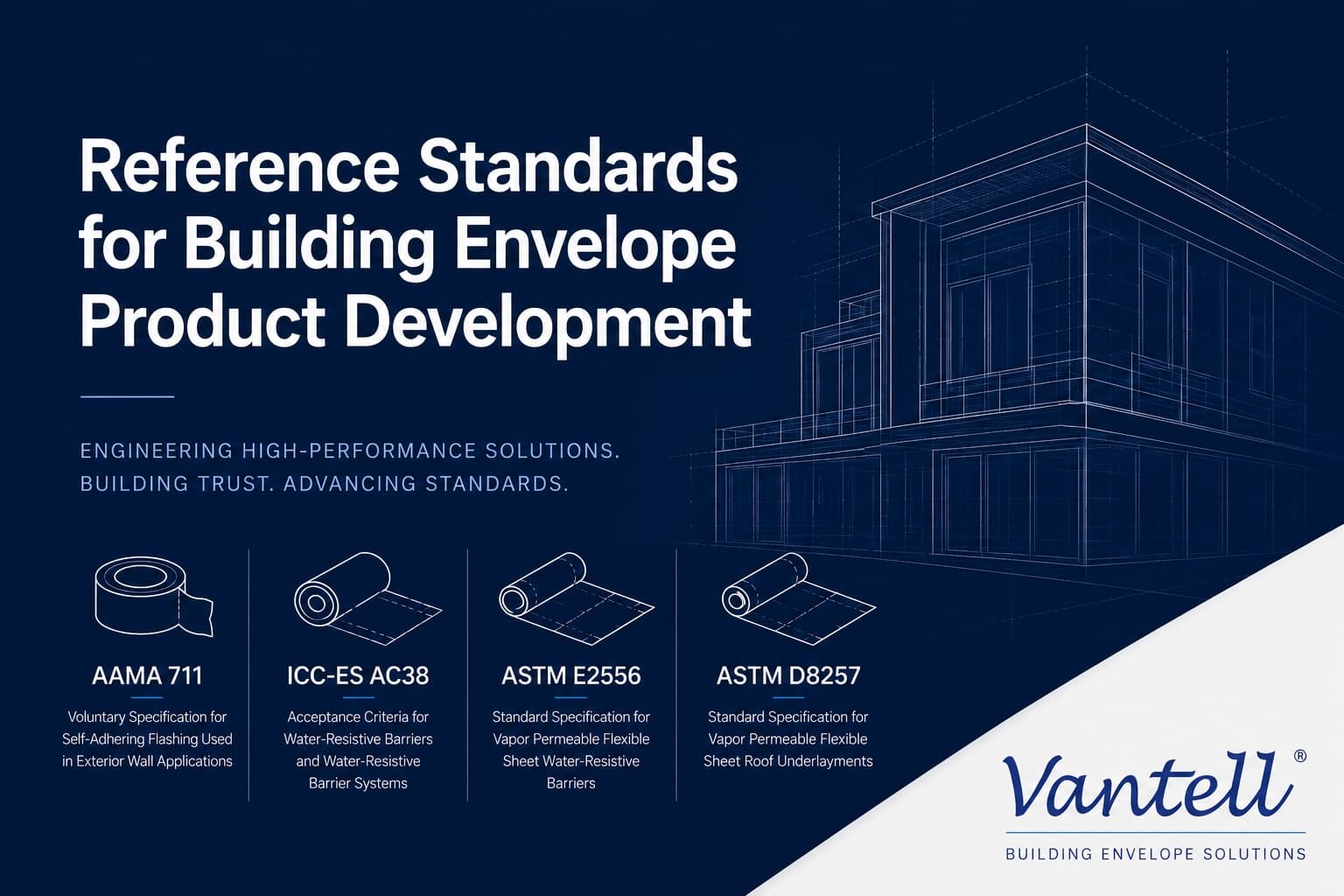
1. Self-Adhered Flashing Tapes: AAMA 711
For window and door flashing applications, AAMA 711 is one of the most important reference standards. It is commonly used for self-adhered flashing products installed around exterior wall fenestration openings.
This standard is especially relevant to window flashing tapes, door flashing tapes, sill flashing, jamb flashing, head flashing and other self-adhered sealing products used around rough openings and critical wall transitions.
AAMA 711 helps evaluate whether a self-adhered flashing material can maintain reliable performance under typical field conditions. Important performance areas include:
- Peel adhesion to common building substrates
- Adhesion after environmental exposure
- Nail sealability
- Water resistance
- Dimensional stability
- Low-temperature application performance
- Heat aging and long-term durability
For Vantell, AAMA 711 is an important development reference for regionally adapted butyl flashing tapes, acrylic flashing tapes and other self-adhered window and door moisture protection products. It helps us focus not only on initial adhesion, but also on long-term sealing reliability around openings.
2. WRB and Housewrap: ICC-ES AC38 and ASTM E2556
For water-resistive barriers and housewrap products, ICC-ES AC38 and ASTM E2556 / E2556M are two important widely used reference documents. These standards are closely related to vapor-permeable flexible sheet water-resistive barriers used behind exterior wall claddings.
ICC-ES AC38 is an acceptance criteria for water-resistive barriers. It is commonly used to evaluate sheet materials installed on exterior walls as water-resistive barriers and, where applicable, as part of an air barrier assembly.
ASTM E2556 / E2556M is a standard specification for vapor-permeable flexible sheet water-resistive barriers. It is especially relevant to mechanically attached breathable WRB and housewrap products installed behind exterior cladding.
For Vantell housewrap and WRB products, these standards help define the overall performance direction, including:
- Resistance to liquid water penetration
- Water vapor permeability
- Mechanical strength
- Installation durability
- Performance behind exterior cladding systems
- Compatibility with wall moisture management requirements
In product development, Vantell uses AC38 and ASTM E2556 as key references for WRB products that need to balance water holdout with vapor permeability. This balance is important because the wall assembly must resist exterior liquid water while still allowing trapped moisture vapor to dry.
3. Water Vapor Transmission: ASTM E96
ASTM E96 / E96M is one of the most widely used test methods for measuring water vapor transmission through building materials. In building envelope applications, this result is often expressed as vapor permeance.
For WRB and housewrap products, vapor permeance is an important property because it helps determine how easily a wall assembly can dry. A suitable perm rating can help reduce trapped moisture risk while still allowing the product to function as a water-resistive layer.
ASTM E96 includes different procedures. For WRB evaluation, Method A, also known as the Desiccant Method, is often referenced. Method selection is important because different procedures may produce different results. For this reason, Vantell pays attention not only to the reported perm value, but also to the exact test method used.
ASTM E96 is useful when comparing standard housewrap, high-perm breathable membranes, vapor-control membranes, drainable WRB products and self-adhered WRB products.
4. Hydrostatic Water Resistance: AATCC 127
AATCC 127 is commonly used to evaluate the resistance of textile and membrane materials to water penetration under hydrostatic pressure. For WRB and housewrap products, this test helps indicate whether a material can resist liquid water under pressure.
For Vantell wall moisture management products, AATCC 127 is an important water-resistance reference. It is especially useful when evaluating whether a WRB can resist water intrusion while still maintaining vapor permeability.
In practical building envelope design, water resistance and vapor permeability must be considered together. A membrane that is breathable but weak against water pressure may not provide sufficient protection. A membrane that is highly water-resistant but has poor drying ability may increase the risk of trapped moisture. The goal is to achieve the right balance for the intended wall assembly.
5. Drainage Performance: ASTM E2273
In high-rainfall or high-humidity regions, drainage behind cladding becomes especially important. A flat WRB may resist water, but water can still be held between closely contacting layers due to capillary action.
When exterior cladding, WRB or sheathing layers are pressed closely together, water may remain trapped in the narrow interface instead of draining freely. Over time, this trapped moisture can increase the risk of sheathing deterioration, mold growth, corrosion, staining and reduced insulation performance.
ASTM E2273 is a useful reference for evaluating drainage efficiency in exterior wall assemblies. It is especially relevant when discussing drainable housewrap, rainscreen products and wall systems that require a designed drainage path behind exterior cladding.
For Vantell drainable WRB and rainscreen products, drainage-related evaluation supports the design goal of moving water downward and out of the wall assembly instead of allowing it to remain trapped between material layers.
Drainage performance can help reduce the risk of:
- Long-term moisture accumulation
- Sheathing deterioration
- Mold growth risk
- Corrosion of fasteners or metal components
- Reduced insulation performance
- Staining or damage behind exterior cladding
6. Roof Underlayment: ASTM D8257 / D8257M
For mechanically attached polymeric roof underlayment used in steep slope roofing, ASTM D8257 / D8257M is an important reference standard.
This standard is relevant to synthetic roof underlayment products designed to function as a water-shedding underlayment layer before and after the installation of the primary roof covering.
For Vantell roofing moisture management products, including synthetic and reflective roof underlayment, ASTM D8257 / D8257M provides a more suitable reference than wall WRB standards because roof underlayment faces different installation conditions, exposure conditions and water-shedding requirements.
Key performance considerations for roof underlayment include:
- Water-shedding performance
- Mechanical attachment performance
- Tear resistance during installation
- Dimensional stability
- Walking surface and handling performance
- Temporary exposure before primary roof covering installation
- Compatibility with steep slope roofing systems
For Vantell reflective roofing underlayment and related roof moisture management products, ASTM D8257 / D8257M is used as a key development reference for polymeric roof underlayment applications.
7. Tensile Strength: ASTM D5034
During transportation, installation and jobsite exposure, WRB and membrane products must withstand pulling, fastening, handling and wind load before the exterior cladding is installed.
ASTM D5034, commonly known as the Grab Test, is often referenced for tensile strength evaluation of textile-type materials and flexible sheet products. For housewrap and WRB products, this test helps determine whether the material has sufficient mechanical strength for real construction conditions.
A WRB should not only perform in laboratory water and vapor tests. It must also remain durable during cutting, fastening, wrapping, overlapping and temporary exposure on the jobsite.
8. Adhesion and Compatibility Testing
For flashing tapes, seam tapes and self-adhered membranes, adhesive performance is one of the most critical factors. A tape must bond reliably to common building substrates and maintain adhesion after exposure to heat, cold, moisture and aging.
Different adhesive systems may be selected depending on the application. Butyl adhesive, acrylic adhesive and other adhesive technologies each have different advantages in adhesion, temperature resistance, conformability and long-term durability.
Important adhesive performance considerations include:
- Initial tack
- Peel adhesion
- Long-term bond strength
- Low-temperature application
- High-temperature stability
- Compatibility with WRB, OSB, plywood, metal, PVC and other substrates
- Resistance to moisture and aging
This is especially important for window and door flashing tapes, WRB seam tapes, roof deck tapes and self-adhered moisture barrier products.
9. Why These Standards Matter
Building envelope failures often occur because materials are evaluated in isolation rather than as part of a complete system. A membrane may be waterproof but not breathable. A tape may have strong initial adhesion but weak aging resistance. A WRB may pass water-resistance testing but still allow moisture to remain trapped if no drainage path is provided.
For this reason, Vantell uses recognized standards as a development framework, not only as a checklist. Our goal is to design products that work together as part of a complete moisture management system.
A complete building envelope moisture management strategy may include:
- Flashing tapes around windows and doors
- Seam tapes for WRB overlaps and joints
- Water-resistive barrier or housewrap
- Self-adhered WRB where required
- Drainable WRB or rainscreen layer
- Roof underlayment and roof detail protection
- Critical-detail sealing around penetrations and transitions
10. Vantell's Development Approach
Vantell develops building envelope products with a system-based approach. Instead of focusing only on one product, we evaluate how membranes, tapes, drainage layers, roof underlayments and flashing components work together in real wall and roof assemblies.
Our development references include AAMA 711 for self-adhered flashing tapes, ICC-ES AC38 and ASTM E2556 for WRB and housewrap products, ASTM E96 for vapor transmission, AATCC 127 for hydrostatic water resistance, ASTM E2273 for drainage evaluation, ASTM D8257 / D8257M for mechanically attached polymeric roof underlayment, ASTM D5034 for tensile strength and other relevant test methods based on product type and customer requirements.
This approach helps us support customers across multiple international markets where water resistance, vapor management, air-tightness, drainage and long-term durability are essential for high-performance building envelope systems.
Conclusion
Standards provide a common technical language for manufacturers, builders, architects, distributors and testing laboratories. For Vantell, they are not only used for compliance discussions, but also as practical tools for product design and continuous improvement.
By referencing recognized standards such as AAMA 711, ICC-ES AC38, ASTM E2556, ASTM E96, AATCC 127, ASTM E2273, ASTM D8257 / D8257M and ASTM D5034, Vantell continues to develop building envelope products that address real moisture management challenges in walls, roofs, windows, doors and critical construction details.
For project-specific requirements, Vantell can discuss suitable product options, test references and customized development directions based on the target market, wall assembly design and performance expectations.