
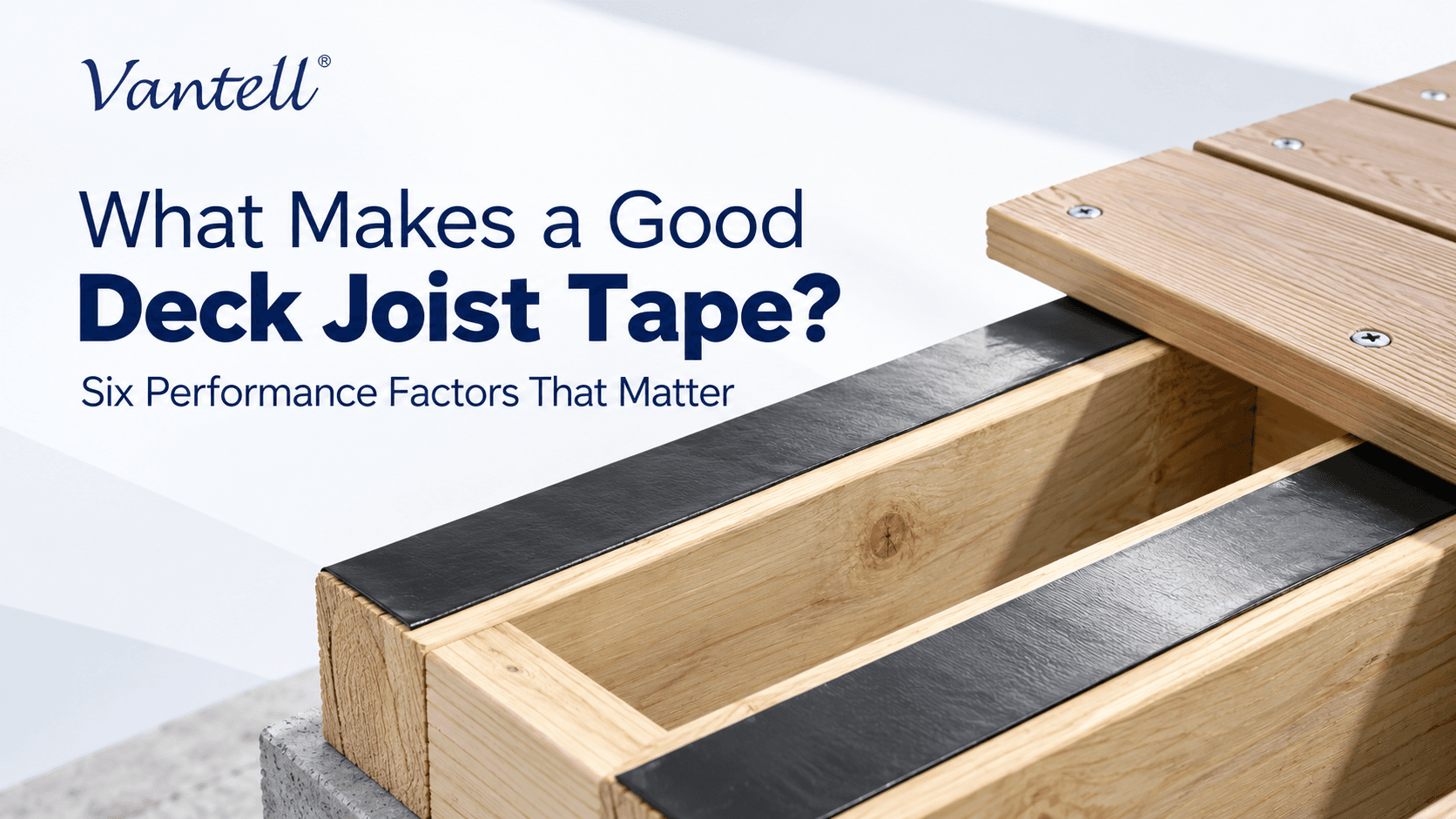
Deck joist tape is a relatively small component in an outdoor deck, but it serves an important purpose: limiting moisture exposure at some of the most vulnerable areas of the wooden substructure.
Deck boards are designed to withstand outdoor conditions, but the supporting joists beneath them face a different challenge. Rainwater passes through the gaps between boards and can remain on horizontal framing surfaces. Screw penetrations, small cracks, and connections between timber members may allow moisture to enter or remain in the wood.
A properly selected deck joist tape creates a protective layer over these surfaces and helps reduce water entry around fasteners. However, not all joist tapes offer the same performance.
A tape that feels extremely sticky may not resist summer heat. A thick adhesive layer may not provide reliable sealing around screws. A tape that performs well on smooth metal may bond poorly to rough or pressure-treated lumber.
So what actually makes a good deck joist tape? The answer involves six interconnected performance factors: fastener sealing, adhesion to wood, moisture resistance, temperature stability, backing construction, and installation performance.
Why Do Deck Joists Need Protection?
Most outdoor decking systems have gaps between adjacent boards. These gaps allow water to drain from the deck surface, but they also expose the underlying joists to rainfall and moisture.
The upper horizontal surface of a joist is particularly vulnerable. Water may remain between the underside of a deck board and the supporting timber, where drying can be relatively slow. Repeated wetting and drying can contribute to checking, dimensional movement, and deterioration over time.
Pressure-treated lumber provides improved resistance to biological decay, but the treatment does not make the wood waterproof. Moisture can still enter through exposed surfaces, end grain, cracks, and fastener penetrations.
Deck joist tape is applied to the top of the framing before installing the decking boards. The tape provides a water-resistant interface intended to reduce direct wetting of the wood and limit moisture entry at fastener locations.
It is important to understand that joist tape is an additional protective measure, not a replacement for proper drainage, suitable lumber, corrosion-resistant fasteners, or good structural detailing.
Fastener Sealing: More Important Than Surface Waterproofing Alone
A waterproof backing film is useful, but waterproofing the surface is only part of the challenge.
During deck installation, screws or nails commonly penetrate the tape and enter the wooden joists. Every penetration creates a potential pathway for moisture.
A good joist tape should help limit water movement along these penetrations.
How Does Self-Sealing Around Fasteners Work?
Many deck joist tapes use a pressure-sensitive adhesive layer, commonly based on butyl rubber or another specially formulated adhesive system.
When a fastener penetrates the tape, the adhesive can deform around the fastener shaft. A suitably formulated adhesive may maintain close contact with the shaft and surrounding material, reducing the opportunity for water to travel through the opening.
The effectiveness of this seal depends on several factors:
- Adhesive flexibility and its ability to conform around the fastener.
- Adhesive cohesion and resistance to displacement.
- The diameter, thread geometry, and installation method of the fastener.
- The condition of the underlying wood.
- Temperature changes and mechanical movement during service.
A softer adhesive may conform readily around a penetration, but excessive softness can also increase the risk of deformation or flow at elevated temperatures. Conversely, a very stiff adhesive may resist movement but struggle to maintain intimate contact with an irregular fastener.
The goal is not simply maximum softness or maximum tack. It is a balance between conformability and long-term stability.
How Should Fastener Sealability Be Evaluated?
A practical evaluation uses representative wood substrates, the intended screws or nails, and a controlled water exposure arrangement.
For example, comparative specimens can be prepared using identical framing materials, tape application conditions, fastener patterns, and water exposure periods. The specimens are then examined for water penetration around the fasteners and into the underlying wood.
Nail-sealability methods developed for other self-adhered waterproofing membranes, such as testing associated with ASTM D1970, can provide useful technical context. However, performance around a smooth nail does not automatically establish equivalent sealing around a threaded deck screw.
Buyers should therefore distinguish between a general self-sealing claim and actual testing performed with representative deck fasteners.
Adhesion to Pressure-Treated Lumber
Even an effective waterproof adhesive cannot protect a joist if the tape separates from the wood.
Adhesion to actual framing lumber is one of the most important factors when selecting deck joist tape.
Wood Is Not a Uniform Bonding Surface
Unlike stainless steel or aluminum, wood is naturally irregular and porous.
Surface roughness, sawdust, moisture content, grain structure, preservative treatment, and weathering can all influence adhesive contact.
Pressure-treated lumber introduces additional variability. Depending on the treatment process and storage conditions, the wood may contain substantial moisture or have surface characteristics that complicate adhesive bonding.
A joist tape that adheres strongly to clean OSB or plywood may not perform identically on freshly treated lumber.
This is why adhesion data obtained only from smooth laboratory substrates should not be treated as proof of compatibility with every type of decking timber.
Initial Tack Is Not the Same as Long-Term Adhesion
Initial tack describes how readily an adhesive establishes a bond during brief contact. It is useful for installation because the tape must remain in position while workers apply and press it.
However, initial tack alone does not demonstrate how the bond will perform after weeks or months of outdoor exposure.
Peel adhesion measures the force required to progressively remove a tape from a substrate under defined conditions. It provides useful information, but the result depends heavily on the test method.
When comparing products, check the substrate, peel angle, test speed, dwell time, application pressure, conditioning procedure, and observed failure mode.
A meaningful joist tape evaluation should include representative pressure-treated lumber, rather than relying exclusively on steel-panel adhesion values.
Long-Term Moisture Resistance
A deck joist tape must function in an environment where repeated water exposure is expected.
Rainfall, overnight condensation, trapped debris, and slow drying beneath deck boards can create prolonged periods of moisture exposure.
A tape may initially resist water penetration but become less effective if the adhesive bond deteriorates or the edges gradually lift.
Long-term moisture performance therefore involves more than the waterproofness of the adhesive layer.
Three aspects deserve particular attention:
- Water resistance of the tape construction: The backing and adhesive should provide a continuous barrier against liquid water within their intended use.
- Wet adhesion durability: The adhesive should maintain suitable contact with the wood after representative moisture exposure.
- Edge stability: The tape should resist progressive lifting or separation that could permit water to travel underneath.
Comparative testing may include controlled water exposure, wet-dry cycling, and inspection of bonded edges and fastener penetrations.
A critical distinction is that water resistance of the tape material does not automatically prove the watertightness of the installed assembly.
Wrinkles, gaps, poorly bonded edges, or unsuitable installation conditions can create leakage paths even when the tape itself is waterproof.
Temperature Stability and Outdoor Durability
Deck framing experiences substantial temperature variation throughout the year.
During summer, dark decking materials exposed to direct sunlight can become considerably hotter than the surrounding air. During winter, the same structure may experience freezing temperatures and repeated thermal cycling.
These conditions can influence the adhesive and backing material in different ways.
High-Temperature Performance
At elevated temperatures, some pressure-sensitive adhesives become softer and more susceptible to deformation.
Excessive softening may contribute to adhesive migration, edge movement, or loss of dimensional stability under sustained loading.
A suitable deck joist tape should maintain sufficient cohesion and adhesion throughout its specified service-temperature range.
Heat resistance should not be evaluated only by checking whether a specimen remains sticky after being placed in an oven.
Useful evaluations include checking for adhesive flow, backing deformation, edge lifting, and changes in peel adhesion following thermal conditioning.
Low-Temperature Performance
Cold weather presents a different challenge. Some adhesives become less flexible as temperature decreases, making it more difficult to form intimate contact with irregular wood surfaces.
A tape that performs well after being warmed and tested at room temperature may still be difficult to install on cold lumber.
This distinction matters because application temperature and service temperature are not the same specification.
Application temperature describes the conditions under which the tape can establish a reliable bond. Service temperature describes the temperature range intended for the material after installation.
Similarly, exposure to an extreme temperature during laboratory conditioning does not automatically establish an equivalent continuous service rating.
UV Exposure During Construction
Although joist tape is normally covered by decking boards, it may remain exposed to sunlight before construction is completed.
The backing should tolerate the intended construction exposure period without unacceptable cracking, embrittlement, or deterioration.
However, descriptions such as "UV-resistant film" should not be confused with a verified maximum exposure period.
If prolonged exposure is anticipated, buyers should request specific UV-weathering information and follow the manufacturer's exposure limitations.
Backing Material and Adhesive Thickness
A joist tape typically combines a protective backing with a pressure-sensitive adhesive layer. These components perform different functions and must work together.
What Makes a Good Backing?
The backing acts as the first protective surface against water exposure and helps the tape withstand handling during construction.
Film-based backings, including suitable polyethylene and other engineered polymer films, are commonly used in deck protection applications.
Important backing characteristics include:
- Resistance to liquid water penetration.
- Appropriate tensile and tear resistance.
- Flexibility around joist edges and irregular details.
- Dimensional stability under temperature changes.
- Resistance to the intended period of UV exposure.
- Ability to withstand normal installation handling.
A backing that is excessively rigid may be difficult to conform around framing edges. One that is too weak may stretch, tear, or become damaged during handling.
The appropriate construction depends on the intended application and installation method.
Is Thicker Joist Tape Always Better?
Not necessarily.
A thicker adhesive layer may improve the ability to accommodate certain surface irregularities or fastener penetrations, but thickness alone cannot predict sealing performance.
Adhesive formulation, viscoelastic behavior, cohesion, compatibility with the backing, and interaction with the substrate can be equally important.
Two tapes with the same total thickness may behave very differently if one uses a relatively thin backing and thick adhesive layer while the other uses a thicker backing and less adhesive.
For meaningful comparison, buyers should request both the total tape thickness and information about the adhesive and backing construction.
Ultimately, the preferred design is one that provides reliable sealing, stable adhesion, and practical installation performance without unnecessary material thickness.
Installation Performance: A Good Tape Must Work on the Jobsite
Laboratory performance is valuable, but installation quality has a major influence on the effectiveness of a completed deck protection system.
A tape that is difficult to handle, conform, or position may create more installation defects than a product with a slightly lower laboratory adhesion value but better application characteristics.
Choose the Correct Width
Joist tape should provide suitable coverage over the upper surface of the framing member.
Single joists, doubled joists, beams, and other framing details may require different tape widths.
Depending on the manufacturer's instructions, the tape may also extend slightly over the edges of the joist to improve protection of the upper corners.
The tape should be wide enough to achieve the intended coverage without excessive folding, wrinkling, or unsupported overhang.
Prepare the Wood Surface
Before application, remove loose sawdust, dirt, debris, and other contamination.
The wood moisture condition should fall within the tape manufacturer's permitted installation range. Unless the product is specifically qualified for damp-substrate application, use a clean, dry surface.
Freshly pressure-treated lumber may require additional drying or a field adhesion check.
Apply Sufficient Pressure
Pressure-sensitive adhesives require good contact with the substrate to develop a reliable bond.
After positioning the tape, apply firm and even pressure along its length, using an appropriate roller or installation tool where recommended.
Pay particular attention to the edges, corners, and transitions between framing members.
Avoid stretching the tape unless its manufacturer specifically permits that installation method. Excessive stretching can introduce tension, increasing the risk of later edge lifting.
Protect the Complete Detail
Deck joist tape is only one element of proper deck moisture management.
Ledger connections, cut ends, posts, beams, and other vulnerable framing locations may require additional protective detailing.
Joist tape should not be used as a substitute for required ledger flashing or other drainage and structural provisions.
Good installation should shed water away from vulnerable connections and avoid creating unintended pockets where moisture can accumulate.
How Should Buyers Compare Deck Joist Tapes?
For distributors, private-label brands, and construction product manufacturers, comparing joist tapes requires more than evaluating price, roll thickness, or initial adhesive tack.
A useful supplier evaluation should include the following:
| Performance Area | What to Verify |
|---|---|
| Fastener Sealability | Water penetration performance around representative nails and deck screws. |
| Wood Adhesion | Peel adhesion on representative pressure-treated and untreated lumber. |
| Moisture Durability | Bond retention, edge stability, and sealing after water exposure. |
| Temperature Stability | Heat conditioning, cold flexibility, adhesive flow, and specified temperature ranges. |
| Backing Construction | Water resistance, tear resistance, flexibility, and UV exposure limitations. |
| Installation Performance | Surface preparation requirements, application temperature, pressure, conformability, and available widths. |
Not every supplier will have the same testing program, and results obtained using different methods should not be treated as directly interchangeable.
For private-label development, a representative assembly test using the intended lumber, fasteners, and installation conditions can be more informative than a single laboratory adhesion number.
Understanding Vantell VDT Series Test Data
Vantell develops butyl-based sealing tapes for applications involving deck framing, sheathing joints, and other moisture-sensitive construction details.
The Vantell VDT Series uses a butyl adhesive layer with a UV-resistant engineered film backing.
As part of its material evaluation, Vantell measures peel adhesion on different construction substrates before and after temperature conditioning.
The following results illustrate the measured 180-degree peel adhesion of the VDT Series on OSB:
| Test Condition | 180° Peel Adhesion |
|---|---|
| Room temperature (28°C), 24 h conditioning | 1.174 N/mm |
| 80°C conditioning for 24 h, then tested at room temperature | 1.122 N/mm |
| -40°C conditioning for 24 h, then tested at room temperature | 1.111 N/mm |
Peel adhesion was measured in accordance with GB/T 2792-2014.
These results indicate that the evaluated specimens retained substantial peel adhesion following the specified short-term thermal conditioning procedures.
They should not, however, be interpreted as direct measurements of adhesive strength at 80°C or -40°C.
Nor do these OSB results alone establish adhesion to all pressure-treated lumber, fastener sealability, or long-term outdoor service life.
These characteristics require additional application-specific evaluation.
For customers developing a deck protection product, Vantell can discuss suitable tape constructions, roll dimensions, substrate requirements, and testing priorities based on the intended application.
Conclusion: The Best Joist Tape Is the One That Maintains Protection Over Time
A good deck joist tape is not defined by one impressive specification.
High initial adhesion is useful, but it does not guarantee long-term bonding. A thick adhesive layer may help with conformability, but thickness alone does not demonstrate fastener sealability. A waterproof backing cannot compensate for poorly bonded edges or incorrect installation.
Reliable performance requires the entire tape construction to work together: the backing resists water exposure, the adhesive bonds to the wood, the sealing layer accommodates fastener penetrations, and the assembly remains stable under relevant environmental conditions.
For contractors, the priority should be compatibility with the framing material and proper installation. For distributors and OEM brands, the priority should be meaningful performance evidence, consistent manufacturing quality, and reliable application-specific testing.
Ultimately, a good deck joist tape should be evaluated by how effectively it helps protect the wood throughout its intended service conditions, not simply by how sticky it feels when the roll is opened.
Explore the Vantell VDT Series Deck Tape or contact Vantell to discuss application requirements, product specifications, and OEM development.