
High-performance buildings are not created by insulation alone. A well-insulated wall or roof can still perform poorly if air is allowed to move freely through joints, penetrations and transitions. In building envelope design, performance depends on the continuity of several control layers: water control, air control, vapour control and thermal control.
Among these layers, continuous airtightness is one of the most important and often one of the most underestimated. It is not simply about stopping drafts. In building science, a continuous air barrier defines the pressure boundary of the building envelope. This pressure boundary helps control how air, heat and moisture move through the assembly.
Airtightness Is the Pressure Boundary of the Building
Air leakage happens when there is both a hole and a pressure difference. The hole may be a small gap in a membrane overlap, an unsealed sheathing joint, a window-to-wall connection, a service penetration or a roof-to-wall transition. The pressure difference may be caused by wind, stack effect or mechanical ventilation.
Wind pressure pushes and pulls on the building envelope. Stack effect occurs when warm air rises inside the building and creates pressure differences between lower and upper levels. Mechanical systems can also create positive or negative pressure if supply and exhaust air are not balanced. When these forces act on a discontinuous air barrier, air will find the weak points and move through them.
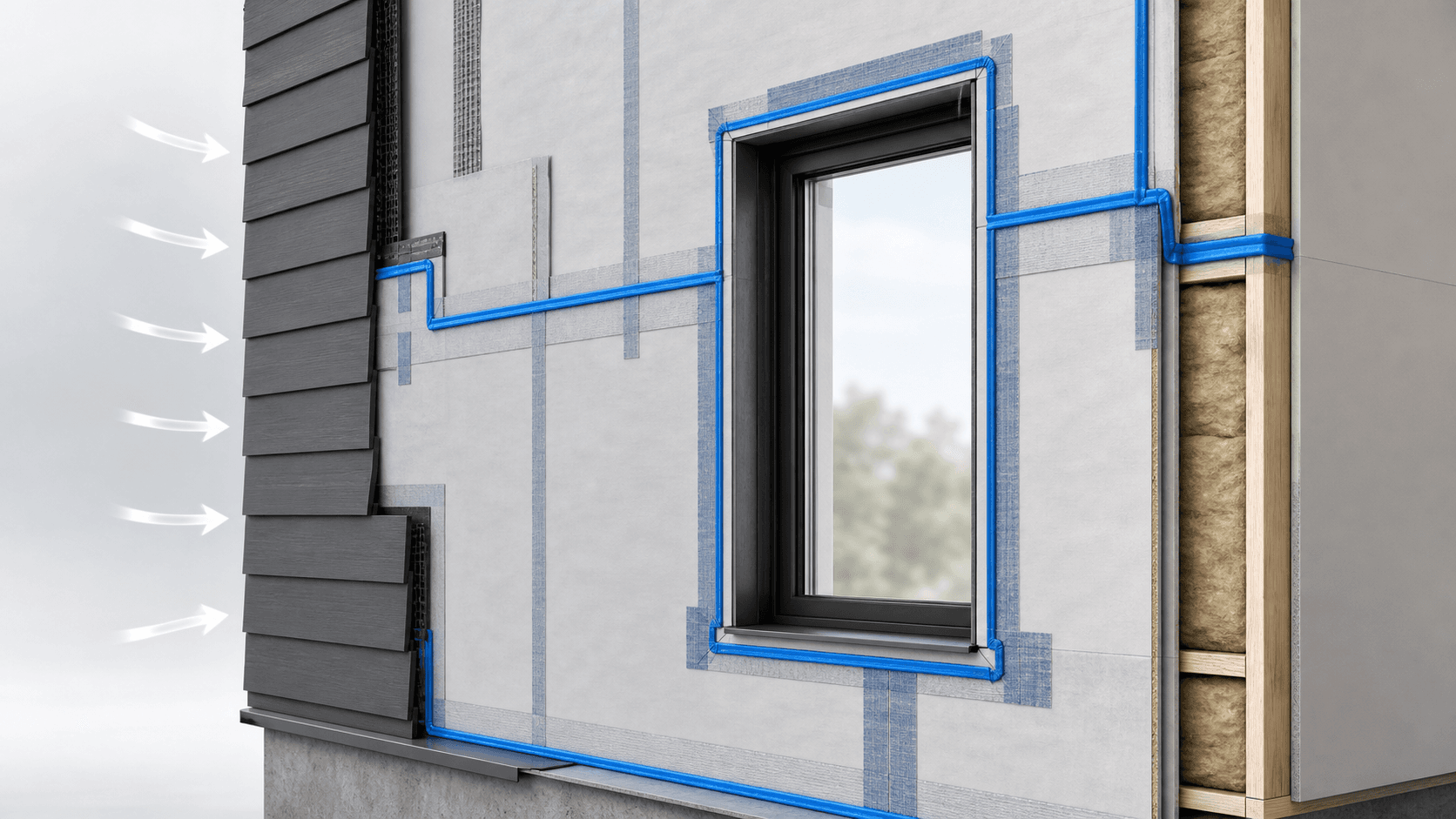
This is why airtightness must be continuous. An air barrier material may have excellent performance in the middle of the sheet, but the building will not be airtight if the joints, laps, corners, openings and penetrations are not sealed. The air barrier must be traceable as one continuous line across the entire building envelope.
Why Air Leakage Can Be More Damaging Than Vapour Diffusion
Moisture can move through a building envelope in different ways. Vapour diffusion is the movement of water vapour through materials. It is usually slow, relatively predictable and strongly influenced by vapour permeability, temperature and humidity difference.
Air leakage is different. Moving air can carry a much larger amount of moisture into a wall or roof assembly within a short period of time. If warm, moisture-laden air leaks into a colder part of the assembly, the moisture may condense on cold surfaces. This can happen behind sheathing, around window openings, inside insulated cavities or at poorly sealed transitions.
For this reason, uncontrolled air leakage is often a greater durability risk than vapour diffusion alone. A wall may be designed with appropriate vapour permeability, drainage and drying potential, but if air leakage is not controlled, moisture can be delivered directly into vulnerable locations.
Energy Performance Depends on Air Control
Insulation is designed to slow heat transfer through the building envelope. However, insulation cannot perform as intended if air is allowed to bypass it. Air leakage can carry conditioned indoor air out of the building and bring outdoor air into the conditioned space.
In cold climates, warm indoor air escaping through gaps increases heating demand and may create condensation risks as it cools within the assembly. In hot or humid climates, outdoor air entering the building increases cooling load and may introduce additional moisture. In mixed climates, the direction and risk can change with season, temperature and building pressure.
A continuous air barrier helps insulation perform closer to its designed value. It reduces uncontrolled air exchange, improves temperature stability and allows mechanical systems to operate in a more predictable way.
Airtight Does Not Mean Vapour Closed
A common misunderstanding is that airtight materials must also be vapour closed. In reality, air movement and vapour diffusion are different physical mechanisms. A material can be airtight while still allowing vapour diffusion.
This distinction is important for modern building envelope design. In many wall assemblies, the exterior layer may need to reduce air leakage and resist wind-driven rain while still allowing the assembly to dry. A vapour-open but airtight approach can help balance air control and drying potential when the wall system is designed correctly.
For example, a vapour-permeable WRB or exterior membrane can contribute to the air-control layer when seams, overlaps and transitions are properly sealed. Compatible vapour-open sealing tapes can help maintain continuity without unnecessarily trapping moisture inside the assembly.
The Air Barrier Must Be Continuous, Not Just Present
Many buildings include materials that could function as part of an air barrier, but the system fails because the air-control layer is not continuous. The critical question is not only “which product is airtight?” but “how does the air barrier connect from one part of the envelope to the next?”
A continuous air barrier should be identifiable in design drawings. In principle, a designer should be able to draw one uninterrupted line around the conditioned space. That line must pass through walls, roofs, foundations, window openings, doors and all major transitions without losing continuity.
On site, this means the design must be translated into real installation details. Membrane overlaps must be sealed. Sheathing joints must be taped. Window and door interfaces must be connected to the surrounding WRB or air barrier layer. Penetrations must be sealed after mechanical, electrical and plumbing work. Roof-to-wall and wall-to-foundation transitions must be planned before they become difficult to access.
Critical Weak Points in the Building Envelope
Most air leakage problems occur at details rather than in the center of large material areas. Common weak points include:
- WRB and housewrap overlaps
- Sheathing board joints
- Window and door perimeters
- Sill, jamb and head flashing connections
- Pipe, cable and duct penetrations
- Electrical boxes and service penetrations
- Roof-to-wall transitions
- Wall-to-foundation transitions
- Corners and changes in substrate
- Damaged or poorly lapped membranes
These areas require more than general attention. They require specific products and specific details. If the correct sealing tape is not used, if the substrate is dusty or wet, if pressure is not applied properly, or if the tape is not compatible with the membrane surface, the continuity of the air barrier may be compromised.
Why High-Performance Buildings Are Less Forgiving
High-performance buildings often use higher insulation levels, improved windows and tighter construction. These improvements reduce heat flow through the envelope, but they can also make moisture mistakes less forgiving.
When an assembly is highly insulated, some parts of the wall or roof may stay colder for longer periods. If air leakage carries indoor moisture into those colder areas, condensation may occur and drying may be slower. This does not mean high-performance assemblies are risky by nature. It means they require better control of air and moisture movement.
The more advanced the building envelope becomes, the more important it is to treat airtightness as a system design issue rather than a simple jobsite repair step.
Continuous Airtightness and Controlled Ventilation
Another common misunderstanding is that buildings need to leak in order to breathe. In high-performance construction, the goal is not uncontrolled leakage. The goal is controlled ventilation.
Uncontrolled leakage is random. It depends on wind, temperature difference, pressure imbalance and accidental construction gaps. It may bring air from dirty, humid or hidden spaces into the building. It may also carry moisture into the envelope where it cannot be seen.
Controlled ventilation is intentional and measurable. A continuous air barrier allows the ventilation strategy to work more effectively because air enters and leaves through designed pathways instead of random gaps in the envelope.
The Role of WRBs, Housewraps and Sealing Tapes
Weather-resistive barriers and housewraps are often the outer protective layer of wall assemblies. They help manage bulk water and wind-driven rain. When properly detailed, they can also become part of the air-control strategy.
However, a WRB or housewrap cannot create continuous airtightness by itself. The seams, laps, edges, openings and transitions must be connected with compatible sealing products. This is where high-performance tapes become critical.
Exterior sealing tapes help connect membrane overlaps, sheathing joints, window and door interfaces and other vulnerable points. Flashing tapes help manage complex openings where water control and air control must work together. Penetration sealing details help maintain continuity after service work is completed.
The performance of these components depends on adhesion, substrate compatibility, temperature range, UV exposure resistance, vapour behaviour and long-term durability. For high-performance buildings, tape selection should be treated as part of the envelope system, not as a generic accessory.
Vapour-Open Airtight Systems
In many wall designs, especially those that need outward drying potential, vapour-open airtight systems can provide an effective balance. The system can reduce uncontrolled air leakage while allowing water vapour to diffuse through the appropriate layer when drying conditions are available.
This is especially relevant for exterior WRB seams, sheathing joints and window-to-wall connections. A vapour-permeable exterior sealing tape can help maintain continuity of the air barrier without turning every exterior detail into a vapour-closed layer.
The correct balance depends on climate, wall design, insulation location, interior vapour control and drying direction. But the principle remains the same: airtightness controls air movement; vapour permeability controls diffusion. These two properties should not be confused.
Airtightness Requires Design and Installation Discipline
Airtightness cannot be fully solved at the end of construction. It must be planned before installation begins. Designers should define the primary air barrier layer and show how it connects at transitions. Builders should use compatible products and follow correct installation procedures.
Important installation considerations include:
- Clean and dry substrates before tape application
- Correct overlap dimensions for membranes and tapes
- Firm pressure during tape installation
- Compatible tapes for the membrane or sheathing surface
- Proper sequencing around windows, doors and penetrations
- Protection of membranes from construction damage
- Clear responsibility for sealing penetrations after service work
Even the best air barrier strategy can fail if installation quality is poor. For this reason, airtightness should be understood as both a design requirement and a construction quality requirement.
How Vantell Supports Continuous Airtightness
Vantell building envelope solutions are designed to support water resistance, air control, vapour management and long-term durability. Our product range includes housewraps, weather-resistive barriers, exterior sealing tapes, window flashing tapes and related building envelope components.
For exterior wall assemblies, Vantell WRB and housewrap systems can provide a protective layer against weather exposure. When combined with compatible sealing tapes, membrane laps, sheathing joints and transitions can be connected into a more continuous air-control layer.
For window and door openings, Vantell flashing tape solutions help seal critical interface areas where water leakage and air leakage risks are concentrated. For vapour-open applications, high-performance acrylic sealing tapes can support airtightness while helping maintain drying potential in suitable wall designs.
The value of a building envelope system is not only in each individual product. It is in how the components work together: WRB layer, seam tape, flashing tape, penetration sealing and transition detailing. This system approach helps reduce weak points and improves the reliability of the whole envelope.
Conclusion
Continuous airtightness is critical for high-performance building envelopes because it defines the pressure boundary of the building. It helps control how air moves through the assembly, how heat is lost or gained, and how moisture is transported into vulnerable areas.
The most important issue is continuity. A building may contain airtight materials, but it will not perform as an airtight building unless those materials are connected across joints, openings, penetrations and transitions.
For high-performance construction, airtightness should be designed as a system. Membranes, WRBs, housewraps, sealing tapes, flashing tapes and installation details must work together. When the air barrier is continuous, compatible and correctly installed, the building envelope can deliver better energy efficiency, improved comfort, stronger moisture control and longer service life.