
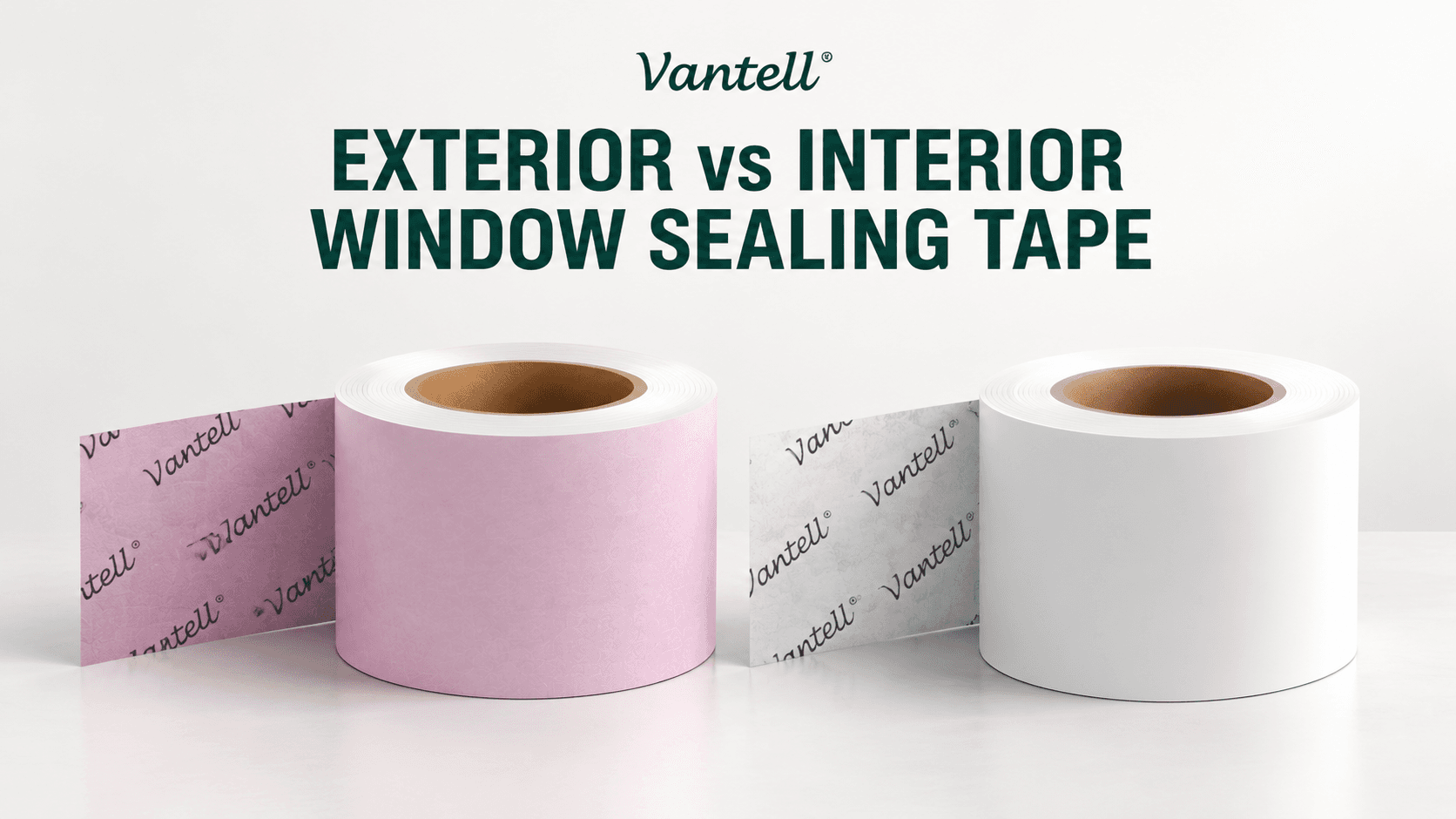
Quick Answer: Exterior vs Interior Window Sealing Tape
Exterior and interior window sealing tapes perform different roles at the window-to-wall connection. Exterior window tape connects the frame to the WRB or exterior weather layer, helping manage wind-driven rain, air leakage and the intended drying path of the wall assembly. Interior window tape connects the frame to the designated interior air-control or vapor-control layer.
In a common three-level window sealing system, the exterior layer provides weather protection, the middle layer provides thermal and acoustic insulation, and the interior layer maintains airtightness and manages indoor moisture movement. These layers must work together as one continuous detail.
| Position | Primary Function | Typical Connection | Typical Material |
|---|---|---|---|
| Exterior | Weather protection, wind resistance and support for the intended drying path. | Window frame to WRB or exterior weather layer. | Exterior breathable window sealing or flashing tape where the assembly requires vapor-open performance. |
| Middle | Thermal and acoustic insulation within the installation joint. | Gap between the window frame and rough opening. | Compatible expanding foam, mineral wool or other specified insulation. |
| Interior | Airtightness and project-specific vapor control. | Window frame to the designated interior air or vapor-control layer. | Interior airtight or vapor-control window tape. |
Compare Vantell exterior breathable flashing tapes and interior air and vapor-control tapes for continuous frame-to-wall connections.
1. Why Window Connections Are Critical Building Envelope Details
A wall assembly is designed with continuous control layers that manage bulk water, air movement, water vapor and heat flow. A window opening interrupts each of these layers and creates a transition between different materials, geometries and exposure conditions.
The connection between the window frame and surrounding wall must accommodate several demands at the same time:
- Wind-driven rain and exterior weather exposure
- Indoor and outdoor air-pressure differences
- Temperature changes and thermal movement
- Water-vapor movement through materials
- Moisture transported by air leakage
- Movement between the frame and wall structure
- Different substrates, coatings and membrane surfaces
- Construction-stage UV, dust and moisture exposure
A window may perform well as a manufactured unit but still contribute to air leakage, water intrusion or condensation if the surrounding connection is incomplete.
Common consequences of poorly designed or installed window connections include:
- Air leakage around the frame
- Cold drafts and reduced occupant comfort
- Water entry during wind-driven rain
- Condensation on concealed surfaces
- Reduced thermal and acoustic performance
- Mold growth and material deterioration
- Corrosion of metal components
- Premature failure of finishes and insulation
A durable window installation is not achieved by applying the strongest or most waterproof tape everywhere. It requires the correct control-layer connection at the correct location.
2. Window Sealing Is a Control-Layer Transition
Window sealing tape is sometimes treated as a simple waterproofing accessory. In a high-performance building envelope, its role is broader. The tape helps reconnect control layers that are interrupted by the opening.
| Wall Control Layer | Function | Window Connection Requirement |
|---|---|---|
| Water-control layer | Drains or sheds bulk water toward the exterior. | Exterior flashing must connect the frame, sill, jambs and head to the WRB in a drainage-compatible sequence. |
| Air-control layer | Limits uncontrolled air movement through the building envelope. | The frame must connect continuously to the project’s designated air barrier, whether that layer is located toward the interior or exterior. |
| Vapor-control layer | Controls water-vapor diffusion through materials. | The tape must provide the vapor resistance required by the climate and wall design without creating an unintended moisture trap. |
| Thermal-control layer | Reduces heat transfer through the wall and window joint. | The installation gap should be insulated continuously without large voids or compression that reduces performance. |
A tape may resist liquid water without having the required vapor permeability. A tape may also be vapor-open while still providing a highly airtight connection. Air permeability and vapor permeability are separate material properties and should not be treated as the same thing.
This distinction is especially important for exterior breathable window tapes. A vapor-open exterior tape is not intended to be air-leaky. It may provide resistance to air and weather while still allowing controlled vapor diffusion through the complete tape construction.
3. The Three-Level Window Sealing Principle
Many high-performance window installations divide the frame-to-wall joint into three functional zones. Each zone addresses a different part of the building-envelope strategy.
Exterior Weather and Drying Layer
The exterior layer protects the joint from rain, wind and environmental exposure. It connects the frame to the WRB, exterior air barrier or other weather-management layer specified for the wall.
Where the wall is intended to dry toward the exterior, the exterior window tape should provide the required vapor-open performance. This allows the connection to resist weather without unnecessarily restricting the assembly’s drying potential.
The exterior tape must also integrate with sill flashing, jamb flashing, head flashing and WRB laps. Tape should not create reverse laps or direct water behind the weather-resistive barrier.
Middle Thermal and Acoustic Layer
The space between the window frame and rough opening is commonly filled with low-expansion foam, mineral wool or another compatible insulation material.
This middle layer reduces thermal bridging and air spaces that can weaken acoustic performance. However, insulation materials are not automatically complete air or vapor-control connections.
Some tested systems may use specific foam products as part of an air-sealing strategy, but this should be confirmed through system documentation rather than assumed from the presence of foam alone.
Interior Air and Vapor-Control Layer
The interior connection limits uncontrolled air movement between the room and the window joint. Where the wall design includes an interior vapor-control layer, the tape also connects the frame to that layer.
This connection is particularly important in heating-dominated climates, where warm and humid indoor air may move toward colder parts of the construction during winter.
Thermal insulation, airtightness and vapor control are different functions. Filling the installation gap does not automatically complete all three.
4. Exterior and Interior Window Tape Compared
| Performance Requirement | Exterior Window Tape | Interior Window Tape |
|---|---|---|
| Main purpose | Weather protection and connection to the exterior WRB or control layer. | Airtightness and connection to the interior air or vapor-control layer. |
| Typical exposure | Rain, wind pressure, temperature changes and temporary construction-stage UV exposure. | Indoor humidity, air-pressure differences and interior environmental conditions. |
| Water management | Must integrate with drainage-compatible sill, jamb, head and WRB details. | Normally protected from direct rain exposure but must remain continuous around the frame. |
| Vapor behavior | May be vapor-open where outward drying is part of the wall design. | May have greater vapor resistance where indoor moisture control is required. |
| Air-control function | May form part of an exterior air-barrier connection in wall systems where the air-control layer is outside the structure. | Commonly forms the primary window air seal in systems using an interior air-control layer. |
| Typical connection | Window frame to WRB, sheathing membrane or exterior weather layer. | Window frame to interior membrane, plaster layer or other designated air/vapor-control layer. |
For exterior connections, Vantell provides VWFAHP Exterior Breathable Acrylic Tape and VWFHYP Exterior Breathable Flashing Tape. These products are intended for exterior window and building-envelope transitions where weather resistance and controlled vapor performance are required.
For interior connections, Vantell offers VWFAIB Interior Vapor Barrier Flashing Tape and VWFAYP Interior Vapor Barrier Flashing Tape for airtight frame connections and vapor-control-layer continuity.
5. Air Leakage and Vapor Diffusion Are Not the Same
Moisture moves through building assemblies in several ways. Understanding these mechanisms helps explain why a waterproof tape alone may not complete a window detail.
Bulk Water Movement
Bulk water includes rainwater and liquid water flowing across surfaces. Window flashing, drainage planes and properly sequenced laps are used to direct this water toward the exterior.
Waterproofing performance is important, but the detail must also provide a drainage path. Even a highly water-resistant tape cannot correct a reverse lap or a sill detail that directs water into the wall.
Vapor Diffusion
Vapor diffusion is the movement of water vapor through materials because of vapor-pressure differences. It is influenced by the vapor permeance or Sd value of the complete material.
European specifications commonly express vapor resistance using Sd value, while North American documentation may use permeance or perms. The correct value depends on the climate and complete wall construction.
Air Leakage
Air leakage is the uncontrolled movement of air through joints, cracks and discontinuities. Airflow can transport much more moisture into a construction joint than vapor diffusion through an intact material.
In cold conditions, humid indoor air can leak through gaps around the frame and contact colder surfaces. If the surface temperature is below the air’s dew point, condensation may occur.
Repeated condensation can contribute to:
- Wood decay
- Mold growth
- Corrosion
- Reduced insulation performance
- Damage to plaster, drywall and interior finishes
Many moisture problems around windows are caused by air leakage rather than vapor diffusion alone. The window frame must therefore connect continuously to the designated air-control layer.
6. Understanding “Inside Tighter Than Outside”
The phrase “inside tighter than outside” is commonly used to describe a window sealing strategy in which the interior connection has greater vapor resistance than the exterior connection.
In a heating-dominated wall designed to dry outward, this arrangement can help reduce indoor moisture movement into the joint while allowing some drying toward the exterior.
However, the word “tighter” can create confusion. It does not mean that the exterior connection should leak air. An exterior window tape can be highly airtight and weather-resistant while remaining relatively open to vapor diffusion.
A more precise version of the principle is:
The interior connection limits air leakage and indoor vapor movement. The exterior connection resists weather while supporting the assembly’s intended outward drying potential.
This principle should not be treated as a universal material rule. The correct vapor profile depends on:
- Heating-dominated or cooling-dominated conditions
- Indoor temperature and humidity
- Exterior insulation position and thickness
- Vapor permeability of the WRB and sheathing
- Reservoir claddings such as brick, stone or stucco
- Ventilated or unventilated rainscreen cavities
- Interior finishes and vapor-control membranes
- The intended inward or outward drying path
Vapor-impermeable materials on both sides of a moisture-sensitive assembly can restrict drying if water enters during construction or service. The window detail should therefore be evaluated as part of the complete wall rather than as an isolated tape selection.
7. Climate and Wall-Assembly Considerations
Cold and Heating-Dominated Climates
During winter, indoor air is usually warmer and may contain more moisture than outdoor air. Air leakage from the interior toward colder parts of the window joint can create condensation risk.
A continuous interior air seal is therefore important. Where the wall design requires interior vapor control, the interior window tape should connect the frame to that vapor-control layer.
The exterior connection should still resist wind-driven rain and integrate with the WRB. If the assembly is designed to dry outward, a vapor-open exterior flashing tape may be appropriate.
Hot and Humid Climates
In hot-humid climates, the dominant vapor drive may move from the warm, humid exterior toward a cooler, air-conditioned interior.
An overly vapor-impermeable interior layer can restrict inward drying in some assemblies. Exterior water management and exterior air-control continuity may become especially important.
Tape selection should therefore follow the specific wall design rather than automatically applying a cold-climate interior vapor-barrier strategy.
Mixed and Marine Climates
Mixed climates may experience both heating and cooling vapor drives during different parts of the year. Marine climates can combine high rainfall, moderate temperatures and long periods of elevated exterior humidity.
Assemblies in these conditions often benefit from carefully managed drying potential. Variable-permeance vapor-control layers, vapor-open exterior membranes or other project-specific solutions may be required.
High-Interior-Humidity Buildings
Swimming pools, commercial kitchens, museums, hospitals and other high-humidity buildings may create moisture conditions that differ significantly from normal residential occupancy.
Window sealing details for these buildings should follow project-specific hygrothermal analysis, engineering requirements and applicable codes.
Select window tapes according to climate, indoor conditions and the complete wall assembly—not according to waterproof performance alone.
8. Window Tape and Airtightness Testing
In energy-efficient and high-performance buildings, the window connection is part of the overall air-barrier system. Small discontinuities around multiple windows can create significant combined air leakage.
During blower-door testing, window interfaces are common locations for investigation. Leakage may occur at:
- Frame corners
- Junctions between sill, jamb and head tapes
- Gaps between tape and rough-opening substrates
- Incomplete connections to interior membranes
- Wrinkles, fish mouths and poorly rolled tape edges
- Fastener penetrations or damaged membranes
- Transitions between different wall materials
Depending on the project, smoke tools, pressure testing, infrared inspection or other diagnostic methods may help identify leakage paths. Final testing should follow the project specification and applicable test procedure.
A durable airtight connection should provide:
- Continuous contact between the tape, frame and control layer
- Compatibility with all connected substrates
- Sufficient flexibility for expected movement
- Reliable adhesion under service temperature conditions
- Properly overlapped corners and junctions
- Protection from exposure beyond the product’s limits
For WRB seams, membrane transitions and exterior air-barrier continuity, Vantell VEXAT-HP High-Perm Acrylic Tape and VSST Acrylic Single-Sided Sealing Tape provide options for building-envelope membrane applications.
For more information about air-control continuity, see Continuous Airtightness in Wall Assemblies.
9. How to Evaluate Window Sealing Tape Performance
Window sealing tape should not be selected only by initial tack, thickness, color or adhesive name. Evaluation should consider the complete product and its role within the assembly.
Substrate Compatibility
Window tapes may need to adhere to wood, OSB, plywood, concrete, masonry, gypsum sheathing, metal frames, PVC frames, coated aluminum, WRB membranes or interior vapor-control layers.
Adhesion to one substrate does not guarantee equal performance on another. Surface energy, texture, dust, moisture, coatings and facer strength can all affect the final bond.
Surface Preparation
Surfaces should be structurally sound and prepared according to the product instructions. Dust, oil, release agents, frost and standing moisture can reduce adhesion.
Porous or mineral substrates may require primer. Field-adhesion testing is advisable when the substrate condition or coating is uncertain.
Installation Pressure
Pressure-sensitive tapes generally require firm rolling or rubbing to develop complete contact. Simply positioning the tape against the surface may leave unbonded areas, particularly on textured substrates.
Water and Weather Resistance
Exterior window flashing tape must tolerate the specified weather exposure and integrate with the building’s drainage strategy. Confirm allowable exposure duration, water-resistance requirements and compatibility with adjacent membranes.
Vapor Performance
The vapor behavior of the complete tape should match its location in the wall assembly. Do not assume that all acrylic tapes are vapor-open or that all butyl tapes are vapor barriers.
Temperature Range
Installation temperature and service temperature are different requirements. A product may perform over a broad service range but still require warmer or drier conditions during installation.
Movement and Flexibility
Window frames and wall materials may move differently because of temperature, moisture and structural loading. The tape should accommodate expected movement without losing adhesion or tearing.
UV and Construction Exposure
Some exterior tapes may be exposed temporarily before cladding installation. Confirm the product’s allowable UV and weather-exposure period rather than assuming indefinite exposure resistance.
Start with the function of the detail, then confirm tested performance, substrate compatibility, environmental exposure and installation requirements.
10. Acrylic vs Butyl Window Sealing Tape
Acrylic and butyl adhesives are both used in window sealing and flashing products. Neither technology is universally better, and neither adhesive name determines the vapor behavior of every finished tape.
| Selection Factor | Acrylic-Based Tape | Butyl-Based Tape |
|---|---|---|
| Initial adhesion | May provide controlled initial tack and develop stronger bonding after application pressure and dwell time. | Often selected where high initial tack and immediate conformability are important. |
| Surface conformity | Suitable for many prepared membranes, boards and frame surfaces depending on the carrier and adhesive design. | Often useful on irregular transitions and demanding flashing details when substrate compatibility is confirmed. |
| Long-term performance | Can be engineered for durable air-barrier, WRB and exterior sealing applications. | Can provide durable waterproof sealing when properly supported, protected and installed. |
| Vapor behavior | Can be designed as vapor-open, vapor-control or vapor-resistant tape. | Can also be designed with different vapor characteristics, including breathable constructions. |
| Typical applications | WRB seams, air-barrier transitions, window connections and vapor-open exterior systems. | Window flashing, sill and corner details, irregular surfaces and waterproof transitions. |
The backing, reinforcement, adhesive thickness and overall construction all affect the final properties. Tape selection should therefore be based on product data and the required assembly function.
For a broader comparison, see How to Choose Building Envelope Tapes: Acrylic, Butyl, Vapor-Open and Vapor-Control Options.
11. Common Window Installation Failures
Failure 1: Using the Same Tape Inside and Outside
Interior and exterior connections may require different vapor, weather and exposure characteristics. One product should only be used in both locations when its documented performance and the wall design support both applications.
Failure 2: Selecting Tape Only by Waterproofing
Water resistance does not automatically provide the required air-control continuity, vapor behavior, movement capability or substrate compatibility.
Failure 3: Relying Only on Expanding Foam
Foam can improve insulation and acoustic performance but should not automatically be treated as the complete frame-to-wall air and vapor-control connection.
Failure 4: Applying Tape to Dusty or Wet Surfaces
Dust, moisture, frost, oil and construction contamination reduce contact between the adhesive and substrate. Cleaning, drying, priming and field testing may be required.
Failure 5: Failing to Roll the Tape
Pressure-sensitive adhesive requires application pressure. Unrolled edges, wrinkles and incomplete contact can create leakage paths.
Failure 6: Creating Reverse Laps
Exterior flashing should be sequenced so that water drains outward. Tape should not direct water behind the WRB or create a pocket at the sill.
Failure 7: Poor Corner and Sill Detailing
Straight tape may bridge, wrinkle or tear at three-dimensional corners. Flexible flashing materials can help form continuous sill and corner transitions.
Vantell VFAST Stretchable Sill and Corner Flashing Tape is designed for sills, corners and irregular opening details where conformability is important.
Failure 8: Ignoring Exposure Limits
Tape that remains exposed longer than permitted may experience UV, dust, rain or temperature conditions beyond its intended construction-stage exposure.
Failure 9: Treating the Window as an Isolated Detail
Window tape must connect to the surrounding WRB, air barrier, vapor-control layer and drainage strategy. A well-sealed frame cannot compensate for discontinuous adjacent membranes.
For additional installation guidance, see Why Flashing Tape Fails to Stick—and How to Fix It.
12. Selecting Window Tape for Different Wall Systems
Timber-Frame Construction
Timber-frame walls frequently use sheet membranes, taped sheathing or interior vapor-control membranes. Window tapes must connect the frame to these layers while accommodating movement and maintaining the intended drying direction.
Concrete and Masonry Construction
Concrete and masonry surfaces may be rough, porous or dusty. Tape selection should consider mineral-substrate adhesion, primer requirements and compatibility with plaster, render and waterproofing materials.
Exterior-Insulated Wall Systems
Exterior insulation can change the temperature profile of the wall and the required location of vapor control. The window detail must connect through or around the insulation to the designated water and air-control layers.
WRB and Rainscreen Assemblies
Window flashing should integrate with the WRB so that incidental water drains into the rainscreen cavity and toward the exterior. Head, jamb and sill sequencing should follow the drainage strategy.
Vantell VWD52315 Drainable Housewrap provides a vapor-permeable WRB with integrated drainage capability for moisture management behind exterior cladding.
Renovation and Replacement Windows
Existing substrates, membranes and control layers may be concealed or incomplete. Before selecting tape, identify the available connection surfaces and determine how the replacement window will integrate with the existing drainage and air-sealing strategy.
For more information about wall control layers, see How to Choose WRB, Air Barrier and Vapor Control Layers.
13. Vantell Window Sealing System Approach
Vantell approaches window sealing as part of the complete building-envelope system. Different areas of the opening require different performance characteristics.
- Exterior breathable window tapes: VWFAHP and VWFHYP for exterior weather-side connections and controlled vapor performance.
- Interior air and vapor-control tapes: VWFAIB and VWFAYP for airtight interior frame connections.
- WRB and membrane sealing tapes: VEXAT-HP and VSST for membrane seams, laps and control-layer continuity.
- Flexible sill and corner flashing: VFAST for complex, three-dimensional opening details.
- Drainable WRB integration: VWD52315 for vapor-permeable weather protection and drainage behind cladding.
The objective is not to use the same material at every location. It is to maintain continuity between the window frame and the water, air, vapor and thermal-control layers of the wall.
Exterior protection, interior airtightness, insulation and vapor control are connected parts of one window sealing strategy. Product selection should follow the actual climate, wall assembly, substrate, exposure condition and project specification.
Frequently Asked Questions
Can the same window tape be used inside and outside?
Not automatically. Interior and exterior connections face different exposure conditions and may require different vapor performance. A multifunction tape should only be used in both positions when its documented properties and the complete wall design support both applications.
Should interior window tape be more vapor-tight than exterior tape?
Often, in heating-dominated assemblies designed to dry outward, the interior connection has greater vapor resistance than the exterior connection. This is not universal. Climate, exterior insulation, cladding, indoor humidity and the intended drying path determine the correct vapor profile.
Does a breathable exterior window tape still provide airtightness?
It can. Air permeability and vapor permeability are different properties. A properly designed exterior tape may resist air leakage and weather while still allowing controlled vapor diffusion through the tape construction.
Is expanding foam enough to make a window airtight?
Expanding foam can improve thermal and acoustic performance, but it does not automatically create a complete and durable frame-to-wall air or vapor-control connection. Follow the documented window sealing system and project specification.
Is acrylic or butyl tape better for window installation?
Neither is universally better. The correct choice depends on the complete tape construction, substrate, movement, temperature, weather exposure, installation conditions and required vapor behavior.
What is the difference between window sealing tape and window flashing tape?
The terms overlap, but their emphasis may differ by market. Window flashing tape commonly refers to products used for exterior water management around sills, jambs and heads. Window sealing tape is a broader term that may include exterior weather tapes, interior airtight tapes and vapor-control tapes.
Does exterior window tape always need to be vapor-open?
No. Vapor-open exterior tape is useful in assemblies designed for outward drying, but the required vapor performance depends on the complete wall system. Follow the project’s moisture-control strategy rather than applying one rule to every climate and construction type.
Tell us your target market, wall assembly, substrate, performance requirement and order quantity. Vantell can help identify suitable exterior flashing, interior air and vapor-control, WRB sealing and flexible detailing options.